MaryRuth’s Liquid Probiotic Lawsuit: Recall, Risks & 2026 Updates
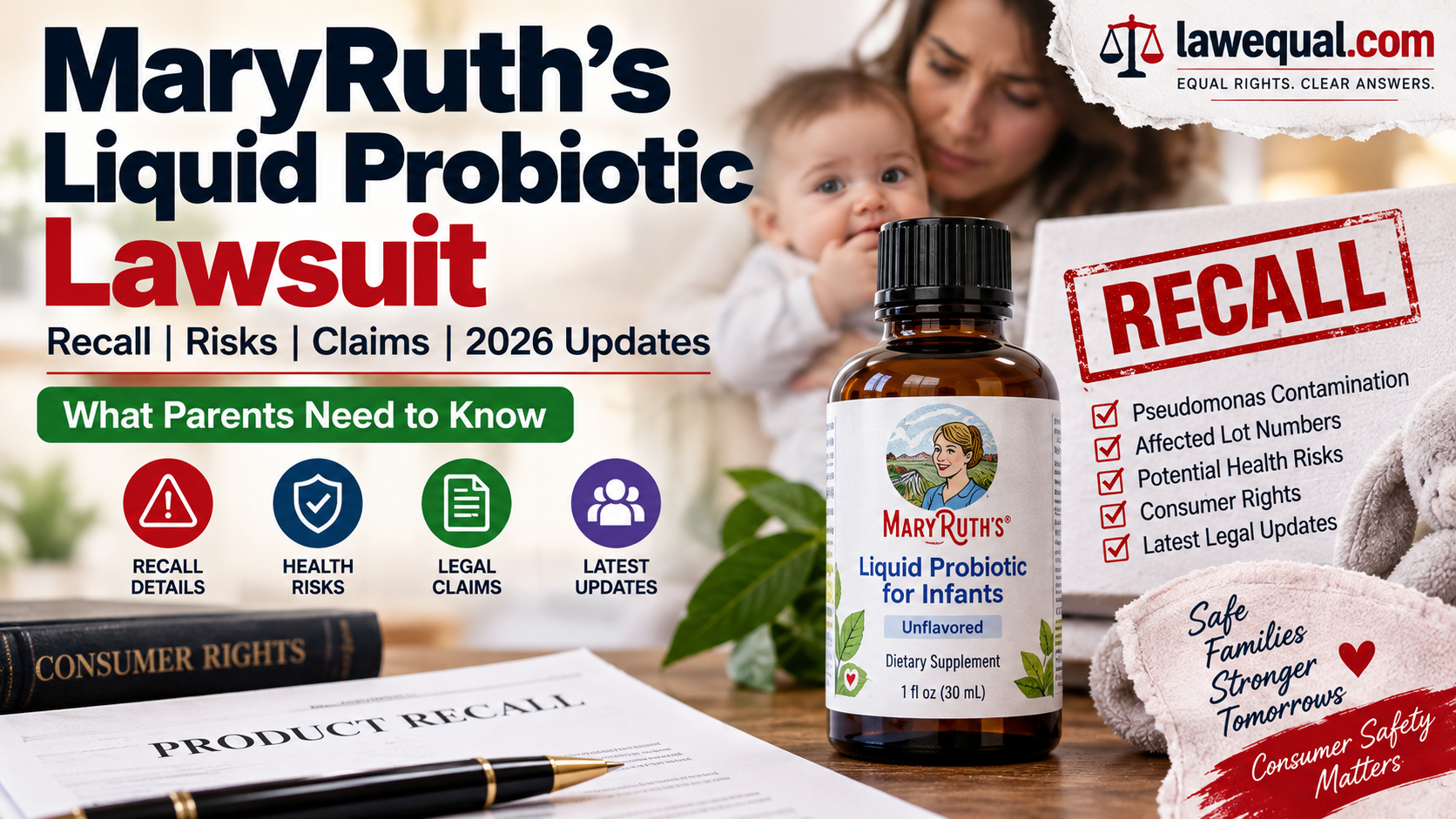
The MaryRuth’s Liquid Probiotic Lawsuit has become a popular search topic among parents and consumers looking for information about MaryRuth’s infant probiotics. Much of the concern comes from a 2021 voluntary recall involving two lots of MaryRuth’s Liquid Probiotic for Infants because of possible Pseudomonas aeruginosa contamination.
However, the recall and a lawsuit are not the same thing. Public information confirms the product recall, but consumers should be careful with online claims suggesting that the infant probiotic recall has already resulted in a class action settlement or compensation program.
What Is the MaryRuth’s Liquid Probiotic Lawsuit?
The phrase MaryRuth’s Liquid Probiotic Lawsuit is commonly used online when discussing the safety concerns surrounding MaryRuth’s Liquid Probiotic for Infants.
The main event behind these searches was a voluntary recall announced on October 29, 2021. MaryRuth’s recalled two lots of its 1-ounce Liquid Probiotic for Infants because of possible contamination with Pseudomonas aeruginosa.
The recall followed routine laboratory testing conducted as part of the company’s quality assurance procedures.
The company said testing involving one of its manufacturing partners identified the potential issue. MaryRuth’s then decided to recall the affected lots as a precaution.
Consumers should understand that a product recall does not automatically mean a lawsuit has been filed. It also does not establish that the manufacturer is legally responsible for an injury.
Is There Really a MaryRuth’s Liquid Probiotic Lawsuit?
As of the information reviewed for this article, reliable public sources confirm the 2021 recall but do not establish a class action lawsuit specifically based on the recalled MaryRuth’s Liquid Probiotic for Infants.
This distinction matters because several different events involving MaryRuth’s can appear together in search results.
MaryRuth’s has been involved in other litigation, including a 2022 trademark dispute. That case did not involve claims that the recalled infant probiotic caused injuries.
Consumers searching for a MaryRuth’s probiotic lawsuit should therefore avoid assuming that every lawsuit involving the company concerns the 2021 recall.
Lawsuit Claims vs. the Confirmed FDA Recall
The October 2021 recall is a documented event.
MaryRuth’s voluntarily recalled two specific lots of its Liquid Probiotic for Infants after routine testing showed a potential contamination issue involving Pseudomonas aeruginosa.
A recall focuses on removing or correcting a potentially unsafe product. A lawsuit is a separate legal process in which a plaintiff asks a court to resolve claims against another party.
The existence of the recall alone does not prove negligence, product liability, or other legal wrongdoing.
Is There a MaryRuth’s Liquid Probiotic Class Action?
No reliable public information reviewed for this article confirms a certified class action specifically involving injuries from the recalled MaryRuth’s Liquid Probiotic for Infants.
There is also no verified class action settlement fund tied specifically to this 2021 infant probiotic recall in the sources reviewed.
This could change if new litigation is filed. Consumers should check current court records before relying on websites that advertise settlement amounts or claim deadlines.
Why Was MaryRuth’s Liquid Probiotic Recalled?
MaryRuth’s announced the recall because of the possibility that certain bottles could contain Pseudomonas aeruginosa.
The issue was discovered through routine laboratory testing connected with one of the company’s manufacturing partners.
MaryRuth’s described the action as precautionary and voluntarily removed the affected products.
Potential Pseudomonas Aeruginosa Contamination
Pseudomonas aeruginosa is a type of bacteria found naturally in the environment.
It can be present in places such as soil and water. For many healthy people, exposure does not necessarily lead to serious illness.
However, the microorganism can cause infections in people with weakened immune systems. Very young or medically vulnerable infants can also face greater risks under certain circumstances.
Because the recalled product was designed for infants, possible contamination raised an important safety concern.
How the Contamination Was Discovered
The potential problem was discovered during routine laboratory testing.
According to the recall announcement, MaryRuth’s quality assurance procedures identified a positive result for Pseudomonas aeruginosa.
The company said the issue involved one of its manufacturing partners.
This is important because the recall was not initially triggered by a large outbreak of reported illnesses. Instead, laboratory testing identified the possible contamination.
Why the Recall Was Voluntary
MaryRuth’s voluntarily initiated the recall.
The company said it took the action out of an abundance of caution after the laboratory result.
A voluntary recall means the company chose to remove the affected products rather than waiting for a mandatory government action.
The FDA published the company’s recall announcement to inform consumers about the affected product and potential risk.
MaryRuth’s Liquid Probiotic Recall Explained
The recall was limited in scope.
It did not cover every MaryRuth’s supplement, every probiotic product, or every bottle of Liquid Probiotic for Infants.
Only two identified lots of the 1-ounce infant probiotic were included.
When Did the Recall Happen?
MaryRuth’s announced the voluntary recall on October 29, 2021.
The FDA published the announcement on the same date.
The affected products had been distributed and sold during a period that ran approximately from May through October 2021.
Consumers who bought the product during that period were advised to check their bottles carefully.
How Many Lots Were Affected?
Only two lots were included in the recall.
They were:
Lot #100420218
and
Lot #100520218
MaryRuth’s specifically stated that no other lots of its Liquid Probiotic for Infants were part of this recall.
The company also said other MaryRuth’s probiotic products were not included.
Was the Recall Nationwide?
The affected products were distributed across the United States through several major sales channels.
They were available through retail and online platforms.
Because consumers could purchase the product online, bottles from the affected lots may have reached families in many locations.
Which MaryRuth’s Liquid Probiotic Products Were Recalled?
The recalled product was specifically MaryRuth’s Liquid Probiotic for Infants.
The bottle size was 1 fluid ounce.
Consumers should not assume that other MaryRuth’s probiotics, vitamins, gummies, drops, or supplements were included in this particular recall.
MaryRuth’s Liquid Probiotic for Infants 1 oz
The product was marketed as a liquid probiotic designed for infants.
The recall covered the 1-ounce bottle associated with the affected lot numbers.
Product identification is important because MaryRuth’s sells many different supplements with similar branding.
Affected Lot Numbers
The two affected lot numbers were:
#100420218
#100520218
Consumers were instructed to look at the product packaging to determine whether their bottle belonged to one of these lots.
If the number did not match either affected lot, the bottle was not included in this specific recall.
UPC and Product Identification Details
The recalled Liquid Probiotic for Infants carried UPC 856645008587.
Consumers could use the product name, bottle size, UPC, and lot number together to help identify affected products.
The lot number is especially important because the recall applied only to two production lots.
How to Check If Your MaryRuth’s Probiotic Was Recalled
Parents should first identify the exact MaryRuth’s product they purchased.
Check the label and packaging for the product name and lot information.
The lot number can be found on the back label of the bottle or on the bottom of the packaging.
Where to Find the Lot Number
Look carefully at the back of the bottle label.
Consumers may also find the identifying information on the bottom of the product’s outer packaging.
Compare the printed number with the two numbers included in the recall.
Recalled Lot #100420218
Lot #100420218 was one of the two lots included in the voluntary recall.
Consumers who still have a bottle carrying this lot number should not use old stock of the recalled product.
The recall instructions told consumers to discard affected bottles and contact MaryRuth’s regarding a refund.
Recalled Lot #100520218
Lot #100520218 was the second affected lot.
The same recall instructions applied to bottles carrying this number.
No other Liquid Probiotic for Infants lots were identified in the October 2021 announcement.
What Is Pseudomonas Aeruginosa?
Pseudomonas aeruginosa is a bacterium commonly found in the environment.
It is especially known for causing infections in people who are medically vulnerable or have weakened immune systems.
The bacteria can cause different types of infections depending on how they enter the body and the health of the person exposed.
Why Can This Bacteria Be Dangerous?
For healthy people, the risk may be lower than it is for medically vulnerable individuals.
People with weakened immune systems can have greater difficulty fighting an infection.
In serious situations, Pseudomonas aeruginosa can spread and affect different areas of the body.
This potential for serious infection is why contamination in a product intended for infants deserves attention.
Risks for Infants and Immunocompromised People
The recall announcement noted particular concern for immunocompromised individuals and, rarely, very young infants.
Infants have developing immune and digestive systems.
The company explained that in vulnerable infants there is a possibility that the bacteria could move through the immature gut and gain access to the bloodstream.
From there, an infection could potentially spread to other areas of the body.
Possible Health Effects of Infection
Possible Pseudomonas aeruginosa infections vary depending on the individual and type of exposure.
Serious infections can affect the blood, lungs, or other parts of the body.
The possibility of severe health consequences is greater in certain medically vulnerable people.
Parents concerned about symptoms in a child should seek advice from a qualified healthcare professional rather than trying to diagnose an infection themselves.
Were Any Illnesses Reported From MaryRuth’s Liquid Probiotic?
At the time of the recall announcement, MaryRuth’s reported receiving one product complaint involving an older infant.
The complaint involved temporary diarrhea.
The company said it did not believe that the diarrhea was related to the microorganism identified during testing.
Report of Temporary Diarrhea
One report of temporary diarrhea in an older infant had been received in connection with the affected product lots.
This report is important to mention accurately.
A reported symptom following product use does not necessarily establish that the product caused the symptom.
What MaryRuth’s Said About the Report
MaryRuth’s said it did not believe the temporary diarrhea was related to Pseudomonas aeruginosa.
The recall announcement did not describe a confirmed outbreak linked to the recalled product.
The recall was instead initiated after laboratory testing identified the potential contamination issue.
What Does the FDA Say About MaryRuth’s Liquid Probiotic?
The FDA published MaryRuth’s recall announcement on October 29, 2021.
The notice identified the reason as potential contamination with Pseudomonas aeruginosa.
The FDA recall page classified the affected product as MaryRuth’s Liquid Probiotic for Infants.
The announcement also provided information about the affected lots, product identification, consumer instructions, and company contact information.
It is important to understand that when the FDA posts a company recall announcement, publication does not mean the FDA endorses the product or every statement made by the company.
Where Were the Recalled Probiotics Sold?
The recalled infant probiotic reached consumers through both physical and online retail channels.
Distribution included Target stores and online platforms.
The broad availability is one reason consumers were encouraged to check their lot numbers rather than assuming their bottle was unaffected based on where they purchased it.
Target Stores and Target.com
The affected infant probiotic was sold through Target.
Consumers could purchase the product at Target stores or through Target’s online shopping platform.
People who purchased the probiotic during the affected sales period were advised to check their bottle’s lot number.
Amazon
The infant probiotic was also available through Amazon.
Online distribution can send products to customers across a large geographic area.
Consumers who purchased through an online marketplace can often use their order history to help confirm when and which product they bought.
MaryRuth Organics Direct Sales
MaryRuth’s also sold products through its own direct channels.
Customers who bought directly from the company were subject to the same lot-based recall criteria.
Where a consumer bought the bottle did not change whether a particular lot was included in the recall.
What Should Parents Do With Recalled MaryRuth’s Probiotic?
The recall instructions were straightforward.
Consumers with bottles from either affected lot were told to discard the product.
They could also contact MaryRuth’s customer care to request a refund.
Stop Using the Affected Product
Consumers should not continue using a product that has been identified as part of a safety recall.
Although the original recall is several years old, an old bottle from an affected lot should not be used if someone still has it.
Parents should check the exact lot number before deciding whether their product was affected.
How to Dispose of a Recalled Bottle
MaryRuth’s instructed consumers with affected bottles to discard the product.
Consumers should follow any current local rules for disposing of household products.
If a consumer is considering a legal claim related to an alleged injury, however, preserving relevant product information and seeking legal advice before disposing of possible evidence may be important.
How to Request a Refund
The original recall offered consumers a full refund for affected products.
MaryRuth’s directed customers to its customer care service to request the refund.
Because the recall occurred in 2021, consumers dealing with an old bottle should verify the company’s current refund process.
MaryRuth’s Liquid Probiotic Lawsuit and Potential Injury Claims
A recall does not prevent a consumer from asking whether an injury may support a legal claim.
Product liability law can sometimes provide legal options when a defective or contaminated product causes a documented injury.
However, the facts of each case matter.
A person generally needs more than proof that they purchased a recalled product. Questions about actual exposure, injury, medical evidence, causation, and applicable law can all be important.
Can Parents File a Claim After an Infant Becomes Ill?
Parents who believe their child became ill after consuming a recalled product can seek legal advice about their individual circumstances.
Whether a valid claim exists depends on the evidence.
A lawyer may consider the affected lot number, purchase records, timing of consumption, symptoms, medical diagnosis, laboratory testing, and other possible causes.
Simply owning a recalled bottle does not prove that an illness resulted from contamination.
Product Liability and Contaminated Supplement Claims
Product liability cases can involve allegations that a product was defective, contaminated, improperly manufactured, or sold without adequate warnings.
A claimant generally must satisfy the legal requirements that apply in their jurisdiction.
Those requirements can differ from state to state.
The 2021 MaryRuth’s recall may be relevant background information, but it does not by itself establish liability in an individual case.
Evidence Parents Should Keep
Consumers who believe an injury occurred should preserve relevant information.
Useful records can include purchase receipts, online order records, photographs of the bottle, packaging, UPC, and lot number.
Medical records may also be important.
Parents can keep notes about when the child consumed the product, when symptoms appeared, what treatment was received, and what healthcare professionals said.
Who May Qualify for a MaryRuth’s Liquid Probiotic Claim?
There is no verified public settlement program identified in the sources reviewed that automatically pays people who purchased the recalled probiotic.
Potential legal eligibility would therefore depend on the type of individual claim being considered.
Purchasing an affected product and suffering a documented injury are different issues.
Parents Who Purchased an Affected Lot
Consumers who purchased lot #100420218 or #100520218 were covered by the recall.
They were eligible to follow the company’s recall instructions, including requesting a refund.
That does not mean every purchaser automatically qualifies for additional legal compensation.
Families Reporting Illness After Product Use
Families who believe an infant became ill after consuming an affected product may have additional questions.
Medical evidence and proof linking an injury to a product can play a major role in a product liability claim.
Anyone considering legal action should also pay attention to applicable statutes of limitations because deadlines can restrict how long someone has to file a claim.
What Compensation Could Be Available in a Product Liability Claim?
Potential damages depend on the facts of an individual case and applicable state law.
There is no fixed MaryRuth’s infant probiotic settlement amount established by the 2021 recall itself.
Possible damages in a successful product liability case can differ greatly based on the injury.
Medical Expenses
Medical costs can form part of damages in some successful injury claims.
These may include doctor visits, emergency care, hospital treatment, testing, medication, and follow-up treatment.
The expenses generally need to be connected to the injury claimed in the case.
Lost Income and Related Costs
Parents may sometimes lose income when they need to take time away from work to care for a sick child.
Whether those losses can be recovered depends on the case and applicable law.
Employment and wage records can help document claimed financial losses.
Pain and Suffering
Some personal injury claims may allow compensation for non-economic harm.
The availability and calculation of these damages vary depending on state law and the circumstances of the injury.
A product recall alone does not create an automatic right to pain-and-suffering damages.
Other Potential Damages
Other documented financial losses may be considered in certain cases.
The type and amount of compensation depend on evidence, causation, legal rules, and the outcome of the claim.
Consumers should be skeptical of websites promising guaranteed payments simply because they purchased the recalled probiotic.
Is There a MaryRuth’s Liquid Probiotic Settlement?
No verified settlement specifically arising from the 2021 MaryRuth’s Liquid Probiotic for Infants recall was established by the reliable sources reviewed for this article.
This is an important point because online searches for product recalls often include terms such as “settlement,” “claim form,” and “payout.”
Search popularity does not prove that a settlement exists.
Is There a Settlement Amount?
There is no verified settlement amount for a class action specifically tied to the 2021 infant probiotic recall in the information reviewed.
Consumers should therefore be cautious about articles quoting large dollar amounts without identifying a court case and approved settlement.
A legitimate class action settlement normally has identifiable court records and formal settlement documents.
Is There a Consumer Claims Form?
The 2021 recall provided a process for requesting a product refund.
A recall refund request is different from a class action settlement claim form.
No verified class settlement claims form specifically tied to the infant probiotic recall was identified in the sources reviewed for this article.
Difference Between the MaryRuth’s Recall and a Lawsuit
A recall is primarily a product-safety action.
Its goal is to remove or address a product that may present a safety concern.
MaryRuth’s voluntarily recalled the two infant probiotic lots after laboratory testing identified possible Pseudomonas aeruginosa contamination.
A lawsuit is a court proceeding.
A plaintiff files legal claims and asks a court for a remedy, which could include monetary damages or another form of relief.
A company can recall a product even when no lawsuit has been filed.
Likewise, a company can be involved in litigation that has nothing to do with a product recall.
Other MaryRuth Organics Lawsuits and Why They Should Not Be Confused
MaryRuth’s has appeared in litigation unrelated to the 2021 infant probiotic recall.
One of the clearest examples is Doctor Danielle LLC v. Maryruth Organics LLC.
This case is sometimes mentioned in articles discussing MaryRuth’s legal history, but it was an intellectual property dispute rather than an infant probiotic injury case.
Doctor Danielle LLC v. MRO MaryRuth LLC
Doctor Danielle LLC filed the case in the U.S. District Court for the Eastern District of Washington on January 11, 2022.
The court docket lists the nature of the case as trademark infringement under the Lanham Act.
MRO MaryRuth LLC was later substituted as the defendant.
The parties eventually agreed to dismiss the case.
On August 10, 2022, the federal court dismissed the matter with prejudice and closed the case.
Why the Trademark Case Is Different From the Probiotic Recall
The Doctor Danielle dispute involved intellectual property and trademark issues.
It did not establish that MaryRuth’s Liquid Probiotic for Infants caused injuries.
The 2021 recall, by contrast, involved a possible bacterial contamination issue affecting two infant probiotic lots.
Combining these events can create a misleading picture.
Readers researching MaryRuth’s legal history should identify the specific product, plaintiff, case number, court, and allegations before treating a lawsuit as connected with the probiotic recall.
MaryRuth’s Liquid Probiotic Lawsuit Latest Updates
The central verified safety event remains the October 2021 voluntary recall.
The affected lots were #100420218 and #100520218.
MaryRuth’s stated that no other Liquid Probiotic for Infants lots and no other MaryRuth’s probiotic products were included in that particular recall.
Search results in 2026 continue to generate questions about lawsuits, claims, and settlements related to MaryRuth’s products.
However, those searches should not be treated as evidence that a class action over the recalled infant probiotic has been certified or settled.
Current Status of the 2021 Recall
The recall announcement remains publicly available as a historical safety notice.
It identifies the product, affected lots, possible contamination, and original consumer remedy.
Because the recall happened in 2021, consumers should distinguish historical recall information from the safety status of products manufactured years later.
A recall of two old production lots does not mean every MaryRuth’s probiotic currently sold is recalled.
What Consumers Should Watch for in 2026
Consumers researching this topic should watch for credible updates from regulators and court records.
A genuine new lawsuit should identify a plaintiff, defendant, court, case number, and allegations.
A class action settlement should have even more specific information, such as court approval documents, eligibility rules, deadlines, and an official claims process.
Avoid assuming a legal advertisement or attorney investigation means a lawsuit has already been filed.
How to Report a Problem With MaryRuth’s Liquid Probiotic
Consumers experiencing a problem with a dietary supplement can report the issue to the appropriate federal authorities.
Parents should document the product name, lot number, UPC, date of purchase, date of use, symptoms, and any medical treatment.
Consumers can also contact the manufacturer regarding product concerns.
If an infant develops concerning symptoms after consuming any supplement, parents should contact a healthcare professional promptly.
Serious symptoms may require immediate medical attention.
Frequently Asked Questions
Is There a MaryRuth’s Liquid Probiotic Lawsuit?
Public information confirms the 2021 MaryRuth’s infant probiotic recall, but reliable sources reviewed for this article do not establish a certified class action specifically based on that recall.
MaryRuth’s has been involved in other lawsuits, which should not automatically be connected to the infant probiotic issue.
Why Was MaryRuth’s Liquid Probiotic Recalled?
MaryRuth’s recalled two lots because routine laboratory testing identified possible Pseudomonas aeruginosa contamination.
The company described the recall as voluntary and precautionary.
What MaryRuth’s Probiotic Lot Numbers Were Recalled?
The affected lots were #100420218 and #100520218.
The recall applied to MaryRuth’s 1-ounce Liquid Probiotic for Infants.
Was MaryRuth’s Liquid Probiotic Contaminated With Bacteria?
The recall concerned the potential presence of Pseudomonas aeruginosa.
Routine laboratory testing produced a positive result that led MaryRuth’s to recall the two affected lots as a precaution.
What Is Pseudomonas Aeruginosa?
Pseudomonas aeruginosa is a bacterium commonly found in the environment, including water and soil.
It can cause serious infections in certain vulnerable people, especially those with weakened immune systems.
Were Any Babies Injured by MaryRuth’s Probiotic?
At the time of the recall, MaryRuth’s reported one complaint involving temporary diarrhea in an older infant.
The company said it did not believe that complaint was related to the microorganism.
The recall notice did not describe a confirmed widespread outbreak caused by the product.
Is MaryRuth’s Liquid Probiotic Safe Now?
The 2021 recall applied only to two specific lots.
It did not cover every MaryRuth’s infant probiotic ever produced or all current MaryRuth’s probiotic products.
Consumers should rely on current product information and safety notices when evaluating products sold today.
Can I Get a Refund for the Recalled Probiotic?
The original recall instructed consumers with an affected bottle to discard it and contact MaryRuth’s for a full refund.
Because the recall dates to 2021, anyone seeking a refund now should confirm the company’s current policy.
Can I File a Claim If My Child Became Sick?
A parent who believes a recalled product caused an illness can consult a qualified attorney about the specific facts.
Eligibility for a product liability claim depends on evidence, causation, applicable law, and filing deadlines.
Is There a MaryRuth’s Probiotic Class Action Settlement?
No verified class action settlement specifically tied to the 2021 Liquid Probiotic for Infants recall was established by the reliable information reviewed for this article.
Consumers should not confuse the original product refund with a class action settlement payment.
Conclusion
The MaryRuth’s Liquid Probiotic Lawsuit search topic mainly traces back to real safety concerns surrounding a 2021 voluntary recall of two lots of MaryRuth’s Liquid Probiotic for Infants. The company recalled lots #100420218 and #100520218 after routine laboratory testing identified the possibility of Pseudomonas aeruginosa contamination.
The recall is well documented, but it should not be presented as proof of a class action, established liability, or an approved settlement. Other lawsuits involving MaryRuth’s, including the closed Doctor Danielle trademark dispute, concern different legal issues.
Consumers researching the MaryRuth’s Liquid Probiotic Lawsuit should therefore separate confirmed recall facts from unverified legal claims. Parents with an affected product should follow appropriate safety guidance, while anyone who believes an infant suffered an injury should preserve relevant records and seek appropriate medical or legal advice based on their individual circumstances.