
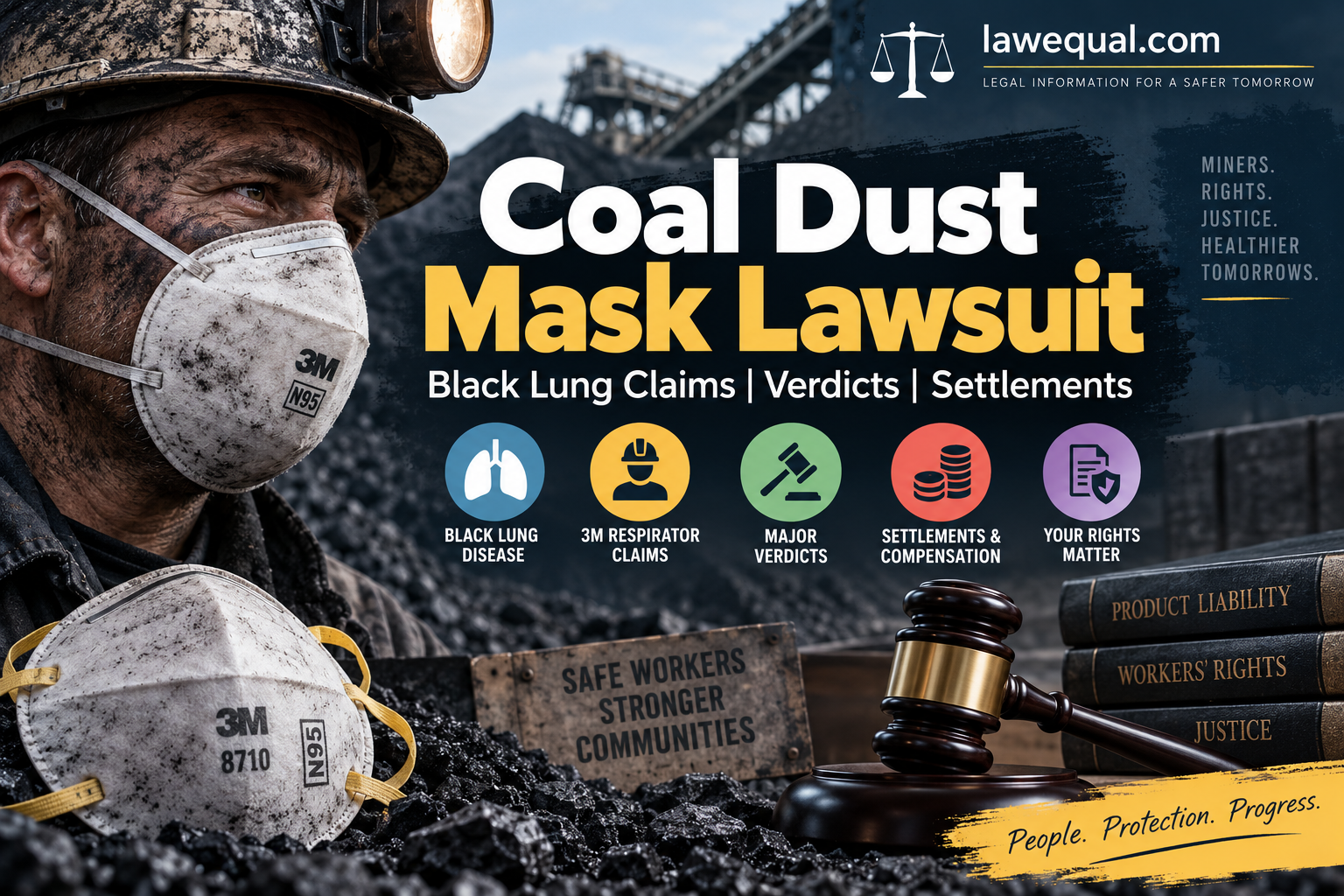
Coal Dust Mask Lawsuit: Black Lung Claims, Verdicts & Settlements
The Coal Dust Mask Lawsuit topic has gained attention among current and former coal miners who developed black lung disease after years of working around coal, rock, silica, and other mine dust. Some miners have filed lawsuits claiming that respirators they wore did not give the level of protection they expected.
Several companies have appeared in coal dust respirator litigation over the years. These include 3M, American Optical, Mine Safety Appliances, Aearo-related companies, Cabot-related companies, and distributors of respiratory protection products.
The cases do not mean that every respirator was defective or that wearing a particular mask caused a miner’s illness. Each lawsuit depends on medical evidence, work history, product identification, exposure, state law, and other facts.
Coal Dust Mask Lawsuit: What Is It About?
Coal dust mask lawsuits generally involve miners who say they wore respirators while working around dangerous dust but later developed serious respiratory disease.
Plaintiffs in these cases have alleged that certain respirators failed to adequately protect them from coal, rock, silica, or other harmful dust.
Claims may involve product liability, negligence, breach of warranty, failure to warn, fraud, or other legal theories depending on the case and state.
Manufacturers have disputed liability in many of these cases. A diagnosis of black lung does not by itself prove that a respirator was defective.
Some cases have reached juries, while others have ended through settlements, dismissals, or summary judgment.
Filing deadlines have become especially important because black lung and other occupational lung diseases may develop over many years.
Why Coal Dust Masks Have Led to Lawsuits
Coal mining can expose workers to very small airborne particles.
The smallest respirable particles can travel deep into the lungs. Long-term exposure can contribute to serious and sometimes permanent lung damage.
Respirators are one part of worker protection. Dust-control systems, ventilation, water sprays, exposure monitoring, proper respirator selection, and correct use can also play important roles.
Litigation developed when some miners who had used respiratory protection later developed lung disease and questioned whether their masks had provided adequate protection.
How Coal Dust Exposure Affects the Lungs
Respirable coal mine dust contains tiny particles that can reach deep lung tissue.
Over time, the lungs may react to repeated dust exposure by developing inflammation and scarring.
Coal workers’ pneumoconiosis is one of the best-known diseases linked to this exposure.
Coal miners can also encounter respirable crystalline silica, particularly during activities involving rock. Silica exposure can cause silicosis and other serious health problems.
The health effects may not become obvious immediately. Occupational pneumoconiosis often develops after years of exposure.
Why Coal Miners Wear Respirators
A respirator is designed to reduce the amount of harmful airborne material a worker breathes when the equipment is appropriate for the hazard and used correctly.
Coal miners have used different respirator types and models over the decades.
Some respirators are disposable filtering facepieces. Others use replaceable filters or cartridges.
The protection a worker receives can depend on the respirator’s design, certification, fit, condition, correct selection, and proper use.
A respirator should also be viewed as one part of a larger dust-control program rather than the only way to control mine dust.
Allegations That Some Dust Masks Failed to Provide Protection
Plaintiffs in respirator cases have alleged that masks failed to provide the protection expected from them.
Some miners have said they could still smell, taste, or see coal dust while wearing masks. Court records in several cases discuss miners noticing dust around or inside their respirators.
These experiences can become part of a lawsuit, but they do not automatically establish that a respirator was legally defective.
Courts may also consider product testing, warnings, regulatory requirements, expert evidence, how the mask was worn, and the miner’s total exposure history.
What Is Black Lung Disease?
Black lung is the common name for coal workers’ pneumoconiosis, often shortened to CWP.
It is an occupational lung disease associated with breathing respirable coal mine dust.
The disease causes changes and scarring in lung tissue. It can range from relatively mild disease to severe respiratory impairment.
Black lung can continue to affect a miner even after the person leaves coal mining.
Coal Workers’ Pneumoconiosis (CWP)
CWP develops from exposure to coal mine dust.
The disease may take many years to become visible on medical imaging or cause serious breathing problems.
Some miners have simple pneumoconiosis, while others progress to a much more serious form.
The disease can reduce a person’s ability to breathe and perform physical activities.
Complicated Black Lung and Progressive Massive Fibrosis
Progressive massive fibrosis, commonly called PMF, is the most severe form of black lung disease.
It is also described as complicated pneumoconiosis or complicated black lung.
Large areas of scar tissue develop in the lungs, which can greatly reduce lung function.
PMF can cause severe disability and may contribute to respiratory failure and premature death.
Recent coal respirator litigation has included miners diagnosed with PMF after earlier diagnoses of occupational pneumoconiosis.
Common Symptoms of Black Lung Disease
Symptoms depend on the severity of lung damage.
Common problems may include:
- Shortness of breath
- Persistent coughing
- Increased phlegm
- Reduced ability to exercise
- Breathing difficulty during normal activities
Symptoms can overlap with other respiratory diseases.
A medical evaluation is therefore important rather than trying to diagnose black lung based only on symptoms.
Can Black Lung Disease Be Cured?
There is currently no cure that reverses the lung scarring caused by black lung.
Treatment generally focuses on managing symptoms, improving breathing, and maintaining quality of life.
Some patients may require medication, pulmonary rehabilitation, supplemental oxygen, or other supportive care.
Preventing or reducing harmful dust exposure remains extremely important because permanent lung damage cannot simply be undone.
3M Coal Dust Mask Lawsuit
3M has been one of the most prominent companies named in coal dust respirator litigation.
Cases have involved miners who said they used 3M respirators while working around coal and other mine dust.
Some plaintiffs alleged that the respirators failed to adequately protect them and contributed to occupational lung disease.
3M has defended its products and disputed allegations that its respirators caused plaintiffs’ illnesses.
Why Coal Miners Filed Claims Against 3M
Many miners spent years working in dusty underground or surface mining environments.
Some were later diagnosed with black lung, COPD, silicosis, PMF, or other respiratory conditions.
Plaintiffs have argued in various lawsuits that they relied on respirators to reduce harmful exposure.
When disease developed despite that use, some miners sued manufacturers and sellers.
The legal issue is more complicated than simply asking whether a miner wore a mask and later became sick.
Plaintiffs generally need evidence supporting the required elements of their claims, including product identification and causation.
3M 8710 Respirator
The 3M 8710 is particularly important in the history of coal dust mask litigation.
Historical government certification records describe the 8710 as a single-use respirator approved in 1972 for protection against certain dusts associated with pneumoconiosis and fibrosis.
Court records show coal miners using the 8710 during earlier decades.
In the Jim Boggs litigation, for example, the court record stated that Boggs used 3M 8710 respirators during part of his mining career.
The 8710 also became central to a major Kentucky jury verdict in 2018 involving two coal miners.
3M 8210 Respirator
The 3M 8210 has also appeared in more recent coal miner litigation.
A 2026 federal case involving a former Kentucky underground miner identified both 3M 8710 and 8210 respirators as products he had allegedly used.
Court records described those products in that case as disposable N95 filtering facepiece respirators certified by NIOSH.
The plaintiff alleged that respiratory equipment failed to adequately protect him from occupational dust exposure.
As with other pending or contested cases, allegations should not be treated as proven facts unless established through the legal process.
Main Allegations Against 3M
Claims vary from case to case.
Common allegations in coal respirator litigation may include defective design, inadequate warnings, negligence, breach of warranty, or misrepresentation.
Some plaintiffs argue that they relied on respiratory protection while continuing to inhale dangerous dust.
Manufacturers may challenge whether the product was defective, whether it was used correctly, and whether it actually caused the claimant’s disease.
3M’s Response to Respirator Claims
3M has denied or contested liability in respirator litigation.
In public corporate disclosures following the 2018 Kentucky verdict, the company said its respiratory products were effective as claimed when used in the intended manner and circumstances.
3M also appealed the Kentucky judgment.
Its public filings have continued to describe occupational respirator litigation involving allegations related to asbestos, silica, coal mine dust, and other workplace dust.
As of March 31, 2026, 3M reported being named with co-defendants in numerous non-Aearo respirator and mask lawsuits involving approximately 3,900 individual claimants across occupational exposure categories, not solely coal dust cases.
Also Read: Residential Elevator Lawsuit
Companies Involved in Coal Dust Respirator Litigation
Coal dust litigation is not limited to one company.
Court records have named manufacturers, corporate successors, distributors, and mine supply businesses.
Which companies belong in an individual lawsuit depends on the products the miner actually used and applicable law.
3M Company
3M, formerly known as Minnesota Mining and Manufacturing Company, has been a major defendant in respirator litigation.
The company manufactured respiratory protection products used in industrial workplaces, including mining.
Its 8710 respirator appears repeatedly in coal mine dust litigation.
More recent court records also reference the 8210.
American Optical Corporation
American Optical has appeared as a defendant in occupational respirator cases.
For example, Jim Boggs sued both 3M and American Optical.
Court records indicated that he used an American Optical respirator during part of his mining career after previously using 3M equipment.
American Optical and related corporate entities have also appeared in later multi-plaintiff respirator litigation.
Mine Safety Appliances Company
Mine Safety Appliances, often referred to as MSA, has been named in coal miner respirator cases.
Historical government records show approved MSA respiratory equipment dating back decades.
Miners in more recent litigation have identified MSA masks among the products they used during their careers.
As with every defendant, being named in litigation does not establish liability.
Aearo Technologies
Aearo Technologies and related Aearo entities have appeared in occupational respirator litigation.
Corporate history can make these cases complicated because respirator businesses and product lines may have changed ownership over time.
Aearo-related litigation can also involve questions about predecessor and successor companies.
Bankruptcy proceedings have further affected the procedural status of some claims involving Aearo entities.
Cabot-Related Companies
Cabot Corporation and Cabot CSC Corporation have also been named in some respirator cases.
Their involvement relates in part to corporate history associated with respiratory product businesses.
Some West Virginia litigation has grouped American Optical, Aearo, and Cabot-related entities together for purposes of discussing manufacturer defendants.
The legal responsibility of any company remains case-specific.
Respirator Distributors and Suppliers
Manufacturers are not always the only defendants.
Mine supply companies and other sellers have also been named in litigation.
Examples appearing in West Virginia court records include Eastern States Mine Supply, Raleigh Mine and Industrial Supply, and United Central Industrial Supply.
Claims against sellers can differ from claims against manufacturers.
State product liability law may also treat distributors differently depending on the circumstances.
Major Coal Dust Mask Lawsuit Cases
Coal dust respirator litigation has developed over many years.
Some cases produced large verdicts. Others were dismissed because of filing deadlines or other legal issues.
These different outcomes show why one famous verdict cannot predict what will happen in another case.
Kentucky Coal Miner Respirator Cases
Kentucky has been an important location for coal respirator litigation because of its long history of coal mining.
One of the most widely reported events occurred in April 2018.
A Kentucky jury found against 3M in a case involving two coal miners and the 3M 8710 respirator.
3M’s own SEC disclosure reported approximately $2 million in compensatory damages and $63 million in punitive damages.
Media reports described the overall jury verdict as $67.5 million before later procedural developments.
3M disputed liability and appealed.
The company also reported settling a number of coal mine dust lawsuits in June 2018 for an amount it described as not material to the company.
West Virginia Coal Miner Cases
West Virginia courts have also handled substantial respirator litigation involving former coal miners.
These cases have named manufacturers and distributors such as 3M, MSA, American Optical, Aearo-related entities, Cabot-related companies, and mine supply businesses.
An important issue in several West Virginia cases has been the statute of limitations.
Courts have examined when miners knew or reasonably should have known they had occupational lung disease and a possible connection to the respirators they used.
That timing can determine whether a lawsuit may proceed.
Boggs v. 3M and American Optical
Jim Boggs worked as an underground coal miner in Kentucky from 1972 until 1986.
Court records state that he used the 3M 8710 during part of his career and later used an American Optical respirator.
Boggs was diagnosed with coal workers’ pneumoconiosis in 1991 and filed for federal black lung benefits.
He and his wife filed suit against 3M and American Optical in 2011, alleging defective respirators contributed to his disease.
The federal district court concluded that the claims were filed outside Kentucky’s applicable statute of limitations.
The Sixth Circuit affirmed the decision in 2013.
The case is important because it shows how a claim can fail because of timing even when a plaintiff alleges a serious occupational disease.
Hardy and Other Coal Miners v. 3M and Respirator Companies
Another important group of cases involved Ronald Hardy and several other West Virginia miners.
The miners had been diagnosed with progressive massive fibrosis, or complicated black lung.
They brought product liability claims against 3M and, depending on the individual case, other manufacturers and distributors.
The litigation raised an important question about whether a later diagnosis of PMF could create a new filing period after an earlier black lung diagnosis.
The procedural history reached West Virginia appellate courts.
In 2025, the Supreme Court of Appeals of West Virginia addressed statute-of-limitations issues in these cases and emphasized the need for a plaintiff-specific analysis of when each miner knew, or reasonably should have known, facts connecting an injury with a possible product claim.
Other Notable Respirator Product Liability Cases
Hundreds of former miners and spouses have appeared in mass tort litigation concerning respiratory protection.
For example, federal court records from Kentucky in 2024 described litigation involving hundreds of former coal miners or their spouses.
Plaintiffs alleged that respirators failed to protect miners from coal, rock, and other dust and that miners developed black lung, COPD, and other injuries.
Courts have dismissed some claims on limitations grounds.
Others have involved disputes over product identification, causation, expert testimony, or other legal issues.
The litigation landscape therefore consists of many individual claims rather than one single nationwide coal dust mask class action.
Coal Dust Mask Lawsuit Verdicts and Settlements
People searching for Coal Dust Mask Lawsuit settlements often want to know whether there is a fixed payout.
There is no universal settlement amount.
Outcomes vary greatly based on the miner’s health, product evidence, exposure history, applicable law, causation evidence, and strength of the case.
Major Jury Verdicts
The 2018 Kentucky verdict involving two miners and the 3M 8710 remains one of the most notable reported outcomes.
3M disclosed that the jury awarded approximately $2 million in compensatory damages and $63 million in punitive damages.
Other reporting described the initial total jury award as $67.5 million.
The company appealed and disputed liability.
A large jury verdict should not be treated as a standard value for another miner’s case.
What Can Affect a Settlement Amount?
Several factors can affect the value of an occupational lung disease claim.
These can include:
- Severity of lung disease
- Progressive massive fibrosis
- Need for oxygen or long-term treatment
- Age of the claimant
- Lost earning ability
- Medical expenses
- Strength of product identification
- Years of respirator use
- Evidence of dust exposure
- Applicable state law
- Statute of limitations
- Strength of expert testimony
- Number and role of defendants
Liability may also be disputed among multiple companies.
Why One Verdict Does Not Predict Another Case
Every miner has a different employment history.
One worker may have used a particular respirator for 20 years, while another may remember several brands and models.
Medical histories also differ.
Smoking history, silica exposure, other workplace hazards, length of coal mine employment, mask fit, and disease severity can all become relevant.
State laws differ as well.
For these reasons, using one large verdict as a guaranteed “payout estimate” would be misleading.
Are Coal Dust Mask Lawsuits Still Being Filed?
Yes. Occupational respirator litigation remains active.
Court records from 2026 continue to show coal workers’ pneumoconiosis claims involving respirator manufacturers.
3M’s 2026 corporate filings also report thousands of pending individual claimants across broader non-Aearo occupational mask and respirator litigation involving asbestos, silica, coal mine dust, and other occupational dust.
This does not mean all pending claimants have black lung or that their allegations will succeed.
Each claim remains subject to its own evidence and defenses.
What Do Coal Miners Claim Was Wrong With the Masks?
The exact allegations differ among lawsuits.
Plaintiffs may argue that a respirator did not provide the protection reasonably expected under actual mining conditions.
Manufacturers may strongly disagree and point to certification, testing, warnings, proper-use requirements, and other evidence.
Alleged Defective Design
A design defect claim argues that the design itself made a product unreasonably dangerous under the applicable state’s legal standard.
In respirator litigation, plaintiffs may focus on filtration, sealing, fit, or other design characteristics.
Proving a legal defect usually requires more than showing that a miner developed black lung.
Technical and expert evidence can be central.
Filtration and Protection Allegations
Some miners have claimed that dust entered their breathing area even when they wore respiratory protection.
Court records describe some workers reporting coal dust on their faces, inside masks, or in their noses after shifts.
Whether such evidence proves product failure depends on the circumstances.
Improper fit, facial movement, use conditions, maintenance, product limitations, and other factors may also matter.
Failure-to-Warn Claims
A failure-to-warn claim focuses on the information supplied with a product.
A plaintiff may allege that warnings failed to adequately explain limitations or risks.
Manufacturers can respond that adequate instructions and warnings were provided.
Historical evidence becomes particularly important when products were sold decades ago.
Marketing and Safety Representation Claims
Some lawsuits may involve statements made about what a respirator was designed to do.
Plaintiffs can argue that they or their employers relied on product representations when choosing respiratory protection.
Defendants may dispute what was actually represented and whether any statement caused the claimed injury.
Packaging, instructions, advertisements, safety documents, and testimony may become evidence.
Negligence and Product Liability
Negligence claims generally focus on whether a company failed to use legally required reasonable care.
Product liability can focus more directly on whether the product itself was defective under state law.
Some lawsuits include several theories at the same time.
A court may dismiss one theory while allowing another to proceed, depending on the evidence and applicable law.
Who May Qualify for a Coal Dust Mask Lawsuit?
There is no automatic national eligibility rule for these lawsuits.
Potential claims depend on individual facts and state law.
A black lung diagnosis alone does not establish that a respirator manufacturer is responsible.
Former and Current Coal Miners
Both former and current coal miners may potentially have claims if the required legal elements can be established.
Work history matters because it helps establish where, when, and how exposure occurred.
Many reported lawsuits involve retired miners whose exposure happened decades earlier.
That long delay makes documentation and filing deadlines especially important.
Workers Diagnosed With Black Lung
A confirmed diagnosis of coal workers’ pneumoconiosis can be important medical evidence.
However, plaintiffs still generally need to connect their alleged injury to a defendant and product.
Medical experts may examine exposure history, imaging, lung function, work records, and other risk factors.
Product experts may address respirator design and performance.
Workers With Progressive Massive Fibrosis
PMF is the most severe form of black lung.
Miners with PMF can face serious breathing limitations and significant future medical needs.
PMF has appeared in major respirator litigation, including West Virginia cases.
However, a later PMF diagnosis does not automatically restart every state’s statute of limitations.
The answer depends on the jurisdiction and facts.
Family Members and Wrongful Death Claims
When a miner dies, certain family members or the estate may have legal rights under state law.
A wrongful death claim can involve allegations that occupational disease contributed to the miner’s death.
Survivors may also qualify separately for federal black lung benefits in some circumstances.
The rules for civil lawsuits and federal benefit claims are different.
Importance of Knowing Which Respirator Was Used
Product identification can become a major issue.
A miner may have worked underground for decades and used several mask brands.
The plaintiff may need evidence showing which manufacturer’s product was actually used and when.
Old photographs, coworkers, mine purchasing records, safety documents, packaging, and employment records may help.
Evidence Needed for a Coal Dust Mask Claim
Older occupational disease cases can be difficult because exposure may have happened decades before diagnosis.
Records may have been lost and companies may have changed ownership.
Gathering evidence early can therefore be important.
Employment and Coal Mining Records
Employment records can establish where and when a miner worked.
They can also show job duties and length of exposure.
Federal black lung applications often contain detailed employment histories.
Workers’ compensation files may provide additional information.
Respirator Brand and Model
Identifying a manufacturer is important, but the exact model can be even more useful.
The 3M 8710, for example, has appeared specifically in several reported cases.
A miner should avoid guessing if the product is uncertain.
Incorrect product identification can weaken a claim.
Medical Records and Black Lung Diagnosis
Medical records can show when symptoms began and when doctors first diagnosed occupational disease.
This evidence matters for both causation and filing deadlines.
Useful records can include chest X-rays, CT scans, pulmonary function tests, treatment notes, oxygen prescriptions, and specialist reports.
Earlier medical records may be just as important as recent ones.
Worksite Dust Exposure History
A miner’s job can affect the amount and type of dust exposure.
Underground drilling, cutting rock, operating roof bolters, continuous mining, and other activities can create different exposure conditions.
Silica exposure can also become relevant.
Detailed work history helps medical and industrial hygiene experts evaluate exposure.
Witness and Coworker Statements
Former coworkers may remember which masks were supplied at a mine.
They may also remember working conditions, dust levels, safety practices, and how respiratory equipment was distributed.
Witness testimony can be particularly useful when old company records no longer exist.
The credibility and detail of the testimony still matter.
Workers’ Compensation and Black Lung Benefit Records
Earlier benefit claims can contain valuable evidence.
They may show when the miner first learned about an occupational lung condition.
This can help a plaintiff prove disease history, but it can also help a defendant raise a statute-of-limitations defense.
The Boggs case is a clear example of why earlier black lung benefit records can become legally important.
Statute of Limitations for Coal Dust Mask Lawsuits
The filing deadline is one of the most important issues in coal respirator litigation.
A potentially strong claim can be dismissed if it is filed too late.
There is no single nationwide statute of limitations for these product liability cases.
When Does the Filing Deadline Begin?
The answer depends on state law.
In some cases, courts examine when the plaintiff knew or reasonably should have known about the injury and its possible cause.
The date of formal diagnosis can matter.
However, earlier symptoms, occupational disease claims, medical discussions, knowledge of dust exposure, or awareness of respirator problems can also become relevant.
Why Black Lung’s Delayed Development Matters
Black lung is a latent occupational disease.
A miner can inhale dangerous dust for years before severe disease becomes clear.
This creates a difficult legal question.
The harmful exposure may have happened decades earlier, while the diagnosis arrives much later.
Discovery rules can help address latent injuries, but those rules differ among states.
Discovery Rule and Latent Disease Claims
A discovery rule can delay the start of a filing period until a plaintiff knew or reasonably should have known certain important facts.
Exactly what a person must know depends on the jurisdiction.
Recent West Virginia litigation shows how fact-specific this analysis can become.
Courts have examined diagnoses, black lung applications, knowledge of mask manufacturers, prior occupational disease awards, and miners’ awareness that dust could enter despite mask use.
Why Filing Deadlines Differ by State
Product liability and personal injury laws are mainly governed by state law.
Kentucky and West Virginia, for example, do not necessarily apply identical rules.
In Boggs v. 3M, the Kentucky federal court applied Kentucky’s one-year personal injury limitations period and found the claims untimely.
West Virginia respirator cases have involved a two-year limitations period and extensive disputes over when that period began.
Anyone evaluating a potential claim should therefore avoid assuming that a deadline mentioned in another miner’s case applies to them.
Coal Dust Mask Lawsuit Compensation
Potential compensation depends on applicable law and proof.
There is no guaranteed settlement amount.
A successful claim may involve economic and non-economic losses.
Medical Expenses
Severe occupational lung disease can create significant healthcare costs.
Expenses may involve specialist visits, imaging, pulmonary testing, medication, rehabilitation, oxygen therapy, hospitalization, and other treatment.
Past medical expenses can be documented through bills and records.
Future medical costs may require expert estimates.
Lost Wages and Reduced Earning Capacity
Breathing problems can make physically demanding mine work impossible.
A miner may need to reduce hours, move to a lower-paying job, or stop working.
A lawsuit may seek lost income when permitted by law.
Permanent disability may also affect future earning capacity.
Pain and Suffering
Serious breathing disease can affect daily life far beyond financial loss.
Walking, climbing stairs, sleeping, exercising, and spending time with family can become difficult.
Some states allow compensation for physical pain, emotional suffering, and loss of enjoyment of life.
Rules for these damages vary.
Permanent Disability
Advanced black lung can permanently reduce lung function.
Some miners require supplemental oxygen and cannot return to physically demanding work.
Permanent disability can affect the value of a claim.
Medical evidence is important for showing the severity and expected duration of impairment.
Future Medical Care
Black lung has no cure, and severe disease can require ongoing treatment.
Future needs may include oxygen, pulmonary rehabilitation, medication, specialist care, and medical equipment.
A serious claim may account for these expected costs.
Future damages must usually be supported by evidence rather than speculation.
Wrongful Death Damages
A wrongful death case may seek compensation when occupational disease allegedly contributes to a miner’s death.
Possible damages depend heavily on state law.
They can include financial losses and other categories allowed by the jurisdiction.
Federal black lung survivor benefits are separate from damages awarded in a civil wrongful death lawsuit.
Coal Dust Mask Lawsuit vs. Federal Black Lung Benefits
A respirator product liability lawsuit and a federal black lung claim are not the same thing.
They involve different legal systems, requirements, defendants, and remedies.
Understanding the distinction is important.
What Are Federal Black Lung Benefits?
The Federal Black Lung Program is administered by the U.S. Department of Labor.
The Black Lung Benefits Act provides benefits to qualifying miners who are totally disabled by pneumoconiosis arising from coal mine employment.
Eligible survivors may also receive benefits in qualifying circumstances.
The program can provide monthly compensation and medical coverage related to pneumoconiosis.
Can a Miner Receive Benefits and File a Product Liability Lawsuit?
Receiving black lung benefits does not, by itself, mean a respirator manufacturer is legally responsible for the disease.
Likewise, product liability litigation is separate from the federal benefits process.
Whether a person can pursue multiple forms of recovery and how those benefits interact depends on the laws involved.
Earlier benefit claims can also become evidence in civil litigation.
They may help establish diagnosis and employment history while also affecting arguments about when the plaintiff knew of the injury.
Workers’ Compensation vs. Respirator Lawsuits
Workers’ compensation generally concerns employment-related injury or disease.
A product liability lawsuit may target a third-party manufacturer or seller of an allegedly defective product.
The standards of proof and available benefits can differ.
State workers’ compensation systems also have their own rules.
How Different Types of Claims May Interact
A miner might have medical records from federal black lung proceedings, state workers’ compensation, and a civil lawsuit.
Information given in one proceeding may become relevant in another.
For example, the date a miner applied for black lung benefits can become important when a court evaluates the statute of limitations.
Consistency and accurate documentation therefore matter.
How Coal Dust Respirators Are Supposed to Work
Respirators are designed to reduce inhalation of airborne contaminants when correctly selected and used.
Different respirators provide different levels and types of protection.
No respirator should be assumed to eliminate all workplace risk.
How Respirators Filter Airborne Dust
A filtering respirator uses filter material to capture particles as air passes through it.
Respirable coal and silica particles can be extremely small.
The respirator must be appropriate for the hazard and working conditions.
The filter is only part of the system because air that leaks around the face seal may bypass the filter.
Importance of Proper Fit
Fit is critical for tight-fitting respiratory protection.
If contaminated air enters through gaps around the face, filtration performance alone may not provide the expected protection.
Facial hair, incorrect size, movement, damaged equipment, and poor positioning can affect the seal.
Workplace respiratory protection programs may require fit testing and training depending on the respirator and regulatory requirements.
NIOSH Respirator Certification
NIOSH evaluates and approves respirators under federal requirements.
Approved respirators carry identifying information related to their certification.
Certification shows that a respirator met applicable approval requirements when evaluated.
It does not mean that the respirator will protect every worker in every environment regardless of fit, selection, condition, or use.
Why Correct Use and Maintenance Matter
A worker needs to use respiratory protection according to its instructions and workplace safety requirements.
Disposable respirators may need replacement when damaged, soiled, difficult to breathe through, or otherwise unsuitable for continued use.
Reusable respirators can require inspection, cleaning, filter replacement, and maintenance.
Training helps workers understand both the benefits and limitations of respiratory protection.
Health Risks Associated With Coal Mine Dust
Coal mine dust can contribute to several respiratory conditions.
Risk depends on factors such as dust concentration, dust composition, duration of exposure, job duties, and individual health.
Coal and silica exposure can occur together.
Black Lung Disease
Coal workers’ pneumoconiosis is directly associated with inhalation of respirable coal mine dust.
It causes lung tissue changes that may become permanent.
Some miners develop mild disease.
Others progress to severe impairment.
Silicosis
Silicosis results from inhaling respirable crystalline silica.
Coal miners can encounter silica when cutting, drilling, or disturbing rock.
Like black lung, silicosis can cause permanent lung scarring.
High silica exposure is a major concern in modern mining health.
Chronic Obstructive Pulmonary Disease
Coal mine dust exposure is also associated with COPD.
COPD can cause airflow obstruction, coughing, shortness of breath, and reduced exercise ability.
Smoking is another major cause of COPD, which can complicate medical causation questions in litigation.
A miner can have more than one respiratory condition.
Progressive Massive Fibrosis
PMF represents severe pneumoconiosis.
Large fibrotic masses develop in the lungs and can greatly impair breathing.
NIOSH has documented concern about severe pneumoconiosis among coal miners.
PMF cases have also become part of modern respirator litigation.
Other Respiratory Problems
Coal mine dust exposure can contribute to chronic bronchitis and lung-function impairment.
Silica exposure adds additional risk.
Medical evaluation is needed to distinguish among conditions because symptoms can overlap.
Accurate diagnosis can also matter in benefits claims and litigation.
How Is Black Lung Disease Diagnosed?
Doctors consider both medical findings and occupational history.
No single symptom is enough to confirm the disease.
Coal miners should tell healthcare providers about their full work and exposure history.
Chest X-Rays
Chest radiographs are widely used in black lung screening and diagnosis.
Specially trained physicians can evaluate X-rays for patterns associated with pneumoconiosis.
The International Labour Organization classification system is commonly used to classify radiographs.
Different readers can sometimes interpret the same X-ray differently.
Lung Function Tests
Spirometry measures how well the lungs move air.
It can help determine whether respiratory impairment is present and how severe it may be.
NIOSH black lung screenings include lung function testing.
Other pulmonary tests may also be ordered depending on the patient’s condition.
Medical and Occupational History
Doctors need to know how long a miner worked around dust.
Job duties, underground or surface work, rock cutting, drilling, respirator use, smoking history, and other exposures can all matter.
The timeline of symptoms is also important.
A detailed history helps place imaging and lung function results in context.
NIOSH Screening for Coal Miners
NIOSH operates the Coal Workers’ Health Surveillance Program.
The program provides periodic black lung screening to U.S. coal miners at no cost.
Screening can include a work and respiratory health questionnaire, chest X-ray, spirometry, and blood pressure measurement.
NIOSH-approved facilities are also available in mining regions.
What Should Former Coal Miners Do After a Black Lung Diagnosis?
A diagnosis can affect health, employment, benefits, and potentially legal rights.
The first priority should be appropriate medical care.
Good recordkeeping can also help with benefits and any future legal questions.
Gather Employment Records
Write down every mining employer you can remember.
Include approximate dates, mines, locations, and job duties.
Keep old pay records, employment documents, union materials, tax records, and safety documents if available.
A detailed timeline can be valuable years later.
Identify Masks and Respirators Used
Try to identify the respirators used at each mine.
Write down manufacturer names, model numbers, appearance, and approximate years of use.
Do not invent details you cannot remember.
Former coworkers may help confirm which equipment the mine supplied.
Preserve Medical Records
Keep copies of X-rays, pulmonary tests, diagnoses, treatment records, and benefit examinations.
Older records can be particularly important because they establish when disease was first detected.
A timeline of diagnoses can also affect filing deadlines.
Maintain records from both private physicians and government benefit programs.
Check Workers’ Compensation and Federal Benefits
Eligible miners may be able to apply for federal black lung benefits.
The Department of Labor program provides monthly benefits to qualifying miners who are totally disabled by pneumoconiosis caused by coal mine employment.
Eligible miners may also receive medical coverage for treatment related to pneumoconiosis.
State workers’ compensation rights should be evaluated separately.
Understand Legal Filing Deadlines
Do not assume that a newly discovered article or later worsening of disease creates a new filing period.
Some miners have lost respirator cases because courts found that they waited too long after learning about their occupational disease.
The correct deadline depends on the state and individual facts.
Early review of the timeline can therefore be important.
How to Identify the Dust Mask You Used in Coal Mines
Product identification can be difficult decades after employment.
Many workers threw away disposable masks after each shift and never kept packaging.
Several types of evidence may help reconstruct what was used.
Look for Manufacturer Information
Think about names or logos printed on masks or boxes.
Manufacturers commonly associated with historical mining respirator litigation include 3M, MSA, and American Optical-related businesses.
Remembering a manufacturer is useful, but an exact model can provide stronger identification.
Avoid assuming that every similar-looking mask came from the same company.
Identify the Model Number
Model numbers may appear in old safety documents, purchasing records, product catalogs, or testimony.
The 3M 8710 is a major example from historical litigation.
The 3M 8210 appears in more recent litigation as well.
Other manufacturers used their own model systems.
Check Old Employment and Safety Records
Mine purchasing records may show which respirators were ordered.
Training materials can show what workers were instructed to wear.
Workers’ compensation files and depositions may also contain product information.
Old photographs from the mine can sometimes provide visual clues.
Ask Former Coworkers
Coworkers who performed the same job may remember the equipment supplied by the mine.
Several people independently remembering the same product can provide useful information.
Still, memories can fade over decades.
Documentary evidence should be preserved whenever possible.
Why Exact Product Identification Matters
A manufacturer generally cannot be held responsible merely because it makes respirators.
The plaintiff must meet the product identification requirements imposed by applicable law.
That can mean showing sufficient evidence that the miner actually used the defendant’s product.
The length and frequency of use may also become relevant to causation.
Current Status of Coal Dust Mask Litigation
Coal dust respirator litigation remains active in 2026.
Recent federal court records continue to involve former coal miners alleging that respiratory protection failed to adequately protect them from harmful mine dust.
A June 2026 federal court decision in Kentucky, for example, concerned a former underground miner who allegedly used 3M 8710 and 8210 respirators and later developed black lung.
The case included allegations of defective and unsafe respiratory protection. As with ongoing litigation generally, allegations are not the same as final findings of liability.
Mass tort cases involving former coal miners have also continued through Kentucky and West Virginia courts.
Many have focused heavily on statutes of limitations and when individual miners had enough information to recognize a possible claim.
West Virginia appellate decisions have shown that the timing analysis may need to consider each miner separately rather than applying one date to everyone.
Meanwhile, 3M’s 2026 SEC reporting shows that broader occupational respirator litigation remains substantial.
As of March 31, 2026, the company reported approximately 3,900 individual claimants in pending non-Aearo respirator and mask lawsuits involving alleged exposure to asbestos, silica, coal mine dust, or other workplace dust.
Those figures should not be interpreted as 3,900 coal dust mask lawsuits. They cover several occupational exposure categories.
There is also no single national settlement program for every miner who used a coal dust mask.
Claims continue to depend on the specific product, diagnosis, exposure history, timing, jurisdiction, and evidence.
Coal Dust Mask Lawsuit FAQs
What is the coal dust mask lawsuit about?
Coal dust mask lawsuits generally involve miners who developed occupational lung disease and allege that respirators they used failed to adequately protect them from dangerous dust.
Cases can involve black lung, COPD, silicosis, or other respiratory conditions.
Manufacturers dispute liability in many cases, and outcomes depend on individual evidence.
Is there a 3M coal dust mask lawsuit?
Yes. 3M has faced numerous lawsuits involving coal miners and respirator products.
The 3M 8710 has been central to several cases.
Litigation involving 3M respiratory protection and occupational dust exposure remains active.
However, there is not one single lawsuit covering every person who ever used a 3M coal dust respirator.
Did 3M respirators cause black lung disease?
Black lung itself is caused by inhaling respirable coal mine dust.
Some plaintiffs have alleged that 3M respirators failed to provide adequate protection and therefore allowed harmful dust exposure.
3M has disputed such claims and has defended the performance of its respiratory products.
Whether a particular respirator contributed to an individual’s injury is a case-specific question requiring evidence.
Which 3M masks are mentioned in coal miner lawsuits?
The 3M 8710 is one of the most frequently discussed respirators in historical coal miner litigation.
The 3M 8210 also appears in recent court records.
Other products may be involved in individual cases.
Exact identification is important because a claimant should not assume which respirator was used.
What is the 3M 8710 dust mask?
The 3M 8710 was a disposable respirator used in industrial settings.
Historical government records show that it received federal approval in 1972 for protection against certain pneumoconiosis- and fibrosis-producing dusts.
Coal miners used the product during earlier decades.
It later became a major product in respirator litigation.
Can I file a lawsuit if I have black lung disease?
Possibly, but a diagnosis alone does not establish a product liability claim.
A claimant may need evidence identifying the respirator, showing exposure and injury, supporting causation, and satisfying other requirements under state law.
The statute of limitations can also determine whether a case may proceed.
Individual legal advice is needed for an actual claim.
Who may qualify for a coal dust mask lawsuit?
Potential plaintiffs may include current or former miners diagnosed with occupational lung disease who can support a legally valid claim involving a particular respirator.
Survivors may have rights in some circumstances.
There is no automatic nationwide qualification list.
Eligibility depends on evidence and applicable law.
How much is a coal dust mask lawsuit worth?
There is no standard payout.
The value depends on factors such as disease severity, disability, medical costs, lost income, product identification, causation evidence, jurisdiction, and available defendants.
A large verdict from another case does not predict the value of a new claim.
Is there a coal dust mask lawsuit settlement?
Some coal dust respirator cases have settled.
3M disclosed that it settled a number of coal mine dust lawsuits in June 2018 for an amount the company described as not material.
Other cases have reached verdicts or been dismissed.
There is no single universal settlement covering every coal miner.
Can retired coal miners file a claim?
Retired status alone does not prevent someone from pursuing a claim.
Many respirator plaintiffs are former miners.
The more important questions include diagnosis, product identification, causation, jurisdiction, and filing deadline.
A decades-old exposure history can make evidence collection more difficult.
Can a family file a wrongful death claim?
Potentially, depending on state law and the circumstances of the miner’s death.
Wrongful death rules determine who may file and what damages may be available.
Federal black lung survivor benefits are separate.
Families should not assume that eligibility for one automatically proves eligibility for the other.
What evidence is needed for a respirator lawsuit?
Useful evidence may include employment records, respirator identification, medical records, X-rays, pulmonary tests, mine records, coworker testimony, exposure history, and benefit records.
Evidence showing when the miner first knew about the disease can also be important.
Expert testimony may be needed to address technical and medical issues.
What is the statute of limitations for a coal dust mask lawsuit?
There is no single nationwide deadline.
The applicable period and when it begins depend on state law.
Some courts focus on when a miner knew or reasonably should have known about the injury and a possible connection to a product.
Because several coal respirator claims have been dismissed as untimely, this issue should not be ignored.
Can I receive federal black lung benefits and still file a lawsuit?
The federal Black Lung Benefits Program and a civil product liability lawsuit are separate legal processes.
Receiving benefits does not automatically establish a lawsuit against a respirator manufacturer.
Prior benefit applications can also become evidence in later litigation.
How different sources of recovery interact depends on applicable law and the specific case.
Final Thoughts
The Coal Dust Mask Lawsuit landscape involves decades of coal mining, occupational dust exposure, black lung disease, respiratory protection products, product liability claims, large verdicts, settlements, and complex filing deadlines. 3M has been a prominent defendant, but American Optical, MSA, Aearo-related companies, Cabot-related companies, and various distributors have also appeared in litigation.
The 3M 8710 has played a major role in historical cases, including a significant Kentucky jury verdict, while recent 2026 litigation shows that respirator claims involving coal workers’ pneumoconiosis have not disappeared. At the same time, many claims have faced major legal obstacles, particularly statutes of limitations.
Current and former miners should remember that developing black lung after using a respirator does not automatically prove that the respirator was defective. Medical history, dust exposure, product identification, respirator use, expert evidence, state law, and filing deadlines can all affect a case.
For miners living with black lung, medical care and available federal or state benefits can also be important regardless of whether a product liability claim exists. Anyone considering an actual Coal Dust Mask Lawsuit should obtain advice based on their own work history, diagnosis, respirator use, and jurisdiction rather than relying on the outcome or settlement amount from another miner’s case..




One Comment