
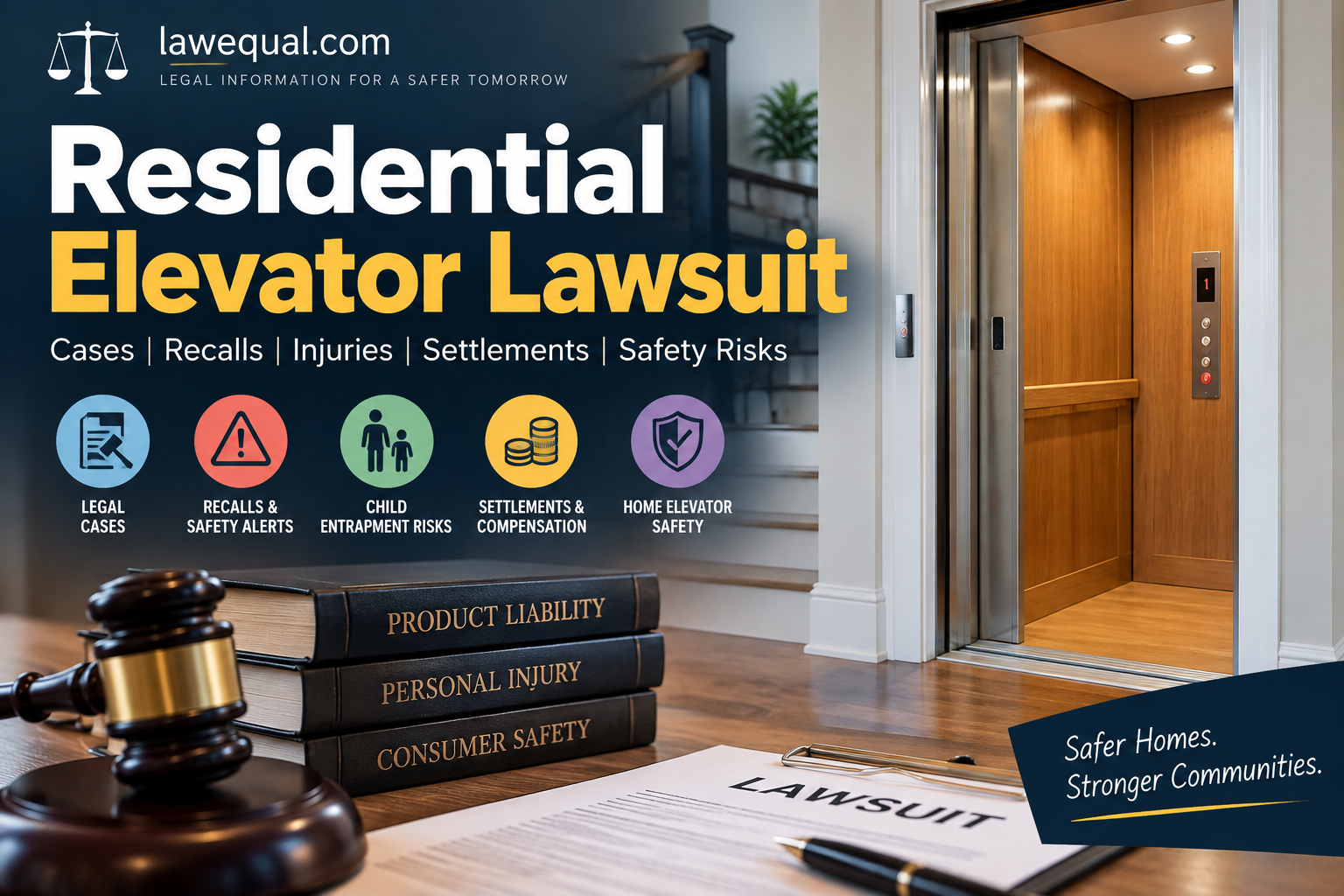
Residential Elevator Lawsuit: Cases, Recalls, Settlements & Safety Risks
The Residential Elevator Lawsuit topic has gained attention because of serious accidents, child-entrapment hazards, product recalls, and legal action involving home elevator manufacturers. One of the biggest concerns involves the space between an elevator’s exterior landing door and its interior car door or gate. A small child can enter this space and become trapped when the elevator moves.
Federal safety officials have taken action against several residential elevator manufacturers over the years. Recalls have affected more than 100,000 elevators, while lawsuits and injury claims have raised questions about product design, warnings, maintenance, installation, and homeowner safety.
Residential Elevator Lawsuit: What Is the Case About?
There is not just one lawsuit involving every residential elevator in the United States. The phrase “residential elevator lawsuit” can refer to different product liability cases, personal injury claims, wrongful death cases, recalls, and government actions involving home elevators.
One of the most important cases involved the U.S. Consumer Product Safety Commission (CPSC) and thyssenkrupp Access Corp., later known as TK Access Solutions Corp. The CPSC filed an administrative complaint in 2021 concerning an alleged child-entrapment hazard.
The case focused on a dangerous space that could exist between the exterior hoistway door and the elevator car door or gate. A young child could fit inside this area without an adult realizing it.
If someone then called the elevator to another floor, movement of the elevator could expose the trapped child to crushing or other severe injuries.
The CPSC and the company reached a settlement in 2022. About 16,800 residential elevators were covered by the resulting recall-to-inspect program.
The settlement did not amount to an admission by the company that its elevators contained a defect or presented a substantial product hazard.
Why Residential Elevators Have Led to Lawsuits
Residential elevators can improve accessibility and make multi-story homes easier to use. However, they contain moving equipment and require proper design, installation, inspection, and maintenance.
Several types of accidents have resulted in legal disputes. Entrapment between doors has received particular attention because children may be able to fit into spaces that adults would recognize as unsafe.
Other cases can involve unexpected elevator movement, falls, leveling problems, defective doors, mechanical failures, or maintenance issues.
When a serious injury occurs, determining why the accident happened becomes an important part of deciding whether a manufacturer, installer, maintenance company, property owner, or another party may have legal responsibility.
The Dangerous Door-Gap Problem
Many home elevators have two separate barriers at each landing. An exterior hoistway door separates the hallway from the elevator shaft, while another door or gate is attached to the elevator car.
A space can exist between these two barriers when both are closed.
If that space is large enough, a small child may enter it and become trapped after the exterior door closes.
The situation becomes especially dangerous if the elevator is called to another floor. The moving car can pin, crush, or otherwise seriously injure a child trapped in the space.
This gap has become one of the central safety issues associated with residential elevators.
Child Entrapment and Crushing Risks
Young children face a greater risk because their bodies can fit into relatively narrow spaces.
A child may enter the area between the landing door and elevator gate without understanding the danger. Once the outer door closes, another person may operate the elevator from a different floor.
Serious entrapment incidents have resulted in catastrophic injuries and deaths.
Because of this danger, regulators have repeatedly advised consumers to prevent children from accessing potentially unsafe elevators until the elevator has been inspected and any needed safety measures have been installed.
Other Residential Elevator Safety Hazards
Door-gap entrapment is not the only issue associated with home elevators.
Possible hazards can include unexpected cab movement, a cab falling or stopping suddenly, unsafe access to the shaft, door or interlock failures, poor leveling, defective components, and improper maintenance.
The exact danger depends on the elevator’s design, age, installation, condition, and maintenance history.
For example, Waupaca residential elevators were previously recalled over a different hazard involving elevator cabs that could fall unexpectedly and stop abruptly.
History of Residential Elevator Lawsuits
Concerns about residential elevator safety did not begin with one recent case.
Door-gap hazards have been discussed within the elevator industry for many years. Over time, serious accidents, lawsuits, safety campaigns, updated codes, recalls, and government action increased public awareness.
Legal cases have also encouraged closer examination of what manufacturers and other companies knew about potential hazards and when they knew it.
Early Reports of Elevator Entrapment
Entrapment accidents involving children have been reported over several decades.
Some earlier cases involved children becoming trapped between a swing-style landing door and an interior elevator gate. These incidents helped demonstrate how dangerous a large clearance between two doors could become.
One widely discussed case involved eight-year-old Tucker Smith, who died in 2001 after becoming trapped in a residential-style elevator door space at a Maine inn.
His family pursued a wrongful death case. The matter reportedly resulted in a $3 million settlement and safety-related commitments.
The case became important in discussions about the history of the door-gap hazard.
Growing Safety Concerns
As additional incidents occurred, safety advocates and injured families pushed for stronger action.
Attention increasingly focused on whether relatively simple modifications could prevent children from entering hazardous spaces between elevator doors.
Space guards became an important part of the response. These devices are designed to reduce the usable depth of the gap between the exterior door and elevator car door or gate.
Public awareness also increased as reports covered accidents involving home elevators in private residences and vacation properties.
How Federal Regulators Became Involved
The CPSC is the federal agency responsible for addressing safety risks associated with many consumer products.
The agency issued safety communications about residential elevator entrapment hazards and encouraged consumers to examine the space between elevator doors.
Eventually, regulators pursued recalls involving multiple manufacturers.
The CPSC also took the less common step of filing an administrative complaint against thyssenkrupp Access Corp. after a voluntary recall had not been reached at that stage.
CPSC Residential Elevator Lawsuit Against Thyssenkrupp
The CPSC’s action against thyssenkrupp Access Corp. became a central event in the history of residential elevator safety enforcement.
In July 2021, the agency filed an administrative complaint seeking action concerning certain residential elevators.
The CPSC alleged that a hazardous space between the exterior hoistway door and elevator car door or gate could expose children to serious injury or death.
Why the CPSC Filed the Lawsuit
The complaint followed reported incidents involving children.
According to the CPSC, three incidents were associated with the elevators covered by its action.
One incident involved a young child who died. Another involved a three-year-old child who suffered catastrophic injuries and became permanently disabled.
The CPSC sought a remedy that would address potentially hazardous elevators installed in consumers’ homes.
Residential Elevator Models Involved
The eventual recall covered about 16,800 residential elevators.
Model names listed by the CPSC included:
- Chaparral
- Destiny
- LEV
- LEV II
- LEV II Builder
- Rise
- Volant
- Windsor
- Independence
- Flexi-Lift
The elevators were manufactured and distributed under several related company names through 2012. The affected products had been installed in homes.
Consumers should not assume an elevator is recalled merely because it looks similar to one of these products. Model and manufacturer information should be checked against official recall information.
Injuries and Deaths Reported
The CPSC identified three incidents in connection with its case.
A 2010 incident involved a three-year-old child who became trapped and suffered catastrophic brain injuries. The child was left permanently disabled.
Another incident in 2017 involved a two-year-old child who died.
These cases demonstrated why the gap between elevator doors can become extremely dangerous even though the elevator may otherwise appear to operate normally.
How the Lawsuit Was Settled
In September 2022, the CPSC announced a settlement with the company, by then known as TK Access Solutions Corp.
The agreement established a recall-to-inspect program covering approximately 16,800 elevators.
The consent agreement was approved by the Commission by a 4-1 vote.
Importantly, the settlement did not constitute an admission by the company that the elevators were defective or represented a substantial product hazard.
Inspection and Repair Requirements
Under the program, affected homeowners could receive a free inspection.
When necessary, the company would also provide free installation of safety devices known as space guards.
These devices reduce hazardous space between the exterior landing door and the elevator car door or gate.
The CPSC advised homeowners to prevent children from accessing affected elevators until inspections and necessary safety work were completed.
Residential Elevator Recalls
The thyssenkrupp matter was part of a broader safety response across the home elevator industry.
During 2021 and 2022, the CPSC announced recalls involving more than 100,000 residential elevators to address child-entrapment concerns.
Several manufacturers participated in recall programs or other safety actions.
Thyssenkrupp Residential Elevator Recall
The TK Access Solutions recall covered about 16,800 residential elevators.
It followed the settlement of the CPSC administrative case.
Affected homeowners were offered inspections and, where necessary, space guards to address hazardous door clearances.
The elevators covered by the action had been sold for home installation under multiple model names.
Custom Elevator Recall
Custom Elevator Manufacturing became part of the wider discussion about home elevator safety following a fatal accident involving a child at a vacation property.
In 2022, Custom Elevator recalled residential elevators because of the risk that children could become trapped between the exterior landing door and interior elevator car door or gate.
Consumers with potentially affected elevators should identify the manufacturer and model and compare that information with the relevant official recall notice.
Savaria Residential Elevator Recall
Savaria Corporation participated in a voluntary recall announced in January 2022.
The recall addressed the same basic child-entrapment hazard associated with excessive space between residential elevator doors.
Consumers with affected elevators could obtain safety measures designed to reduce hazardous door gaps.
Bella Elevator Recall
Bella Elevator also participated in the 2022 recall actions.
The safety concern involved children potentially entering the space between the exterior hoistway door and the elevator car door.
The recall offered measures intended to reduce the dangerous space.
Inclinator Residential Elevator Recall
Inclinator Company of America was another manufacturer involved in the January 2022 CPSC announcement.
Together, recalls involving Bella, Inclinator, and Savaria covered approximately 69,000 residential elevators.
The companies offered safety devices for elevators with hazardous gaps.
Cambridge Elevating Recall
Homeowners should understand that elevator recalls may involve different hazards and components rather than one universal defect.
Cambridge Elevating products have also been subject to safety actions. Therefore, owners should search by the exact manufacturer, model, and serial information instead of assuming that every recall involves the same door-gap issue.
Checking current official recall information is important because additional safety notices can be announced over time.
Waupaca Residential Elevator Safety Warning
Waupaca elevators have been connected to more than one major safety concern.
In 2018, approximately 8,000 Custom Lift residential elevators were recalled because the elevator cab could fall unexpectedly to the bottom of the shaft and stop abruptly.
CPSC information associated with that recall reported 12 incidents and 10 injuries.
The CPSC later issued an urgent warning concerning Waupaca residential elevators and child-entrapment risks as well.
The agency advised consumers to stop using certain affected elevators until appropriate safety measures were addressed.
Major Residential Elevator Accidents and Injury Cases
Residential elevator accidents vary greatly in severity.
Some result in minor injuries, while others cause brain damage, spinal injuries, crushing injuries, permanent disability, or death.
Serious cases often lead investigators to examine product design, maintenance history, installation records, warnings, inspections, and property conditions.
Child Entrapment Accidents
Child entrapment has become the best-known hazard connected with home elevator litigation.
A child can stand between an outer landing door and an inner elevator gate. If the elevator moves while the child remains there, the child may be crushed or pinned.
The risk can be difficult for guests to recognize, particularly when staying at a vacation rental where they have never used the elevator before.
This is one reason rental-home elevator safety has received special attention.
Fatal Residential Elevator Incidents
Several fatal accidents have influenced safety discussions.
The Tucker Smith case from 2001 became an important earlier example.
The CPSC’s case against thyssenkrupp also referenced a 2017 death involving a two-year-old child.
In 2021, seven-year-old Weston Androw died in an elevator accident at a vacation rental property in North Carolina.
His death contributed to further calls for stronger residential elevator safety requirements.
Also Read: Mary Ruth Organics Lawsuit
Serious Injuries Linked to Home Elevators
Not every victim dies, but survivors can suffer life-changing injuries.
Crushing or entrapment can lead to traumatic brain injury, spinal cord damage, broken bones, nerve damage, breathing-related injuries, and permanent disability.
A severely injured child may require medical treatment, rehabilitation, mobility equipment, home modifications, and long-term personal care.
These future needs can become important when damages are calculated in a lawsuit.
Who Can Be Held Liable in a Residential Elevator Lawsuit?
Liability depends on what caused the accident and the law of the state where it occurred.
There is no automatic rule that makes one party responsible for every residential elevator injury.
An investigation may involve several businesses and individuals.
Elevator Manufacturers
A manufacturer may face a product liability claim when an alleged design or manufacturing defect contributes to an injury.
Questions may include whether the elevator was reasonably safe when sold and whether foreseeable risks could have been reduced through a safer design.
Warnings and instructions may also become important.
Installation Companies
Even a properly designed elevator can become dangerous if installed incorrectly.
An installer may face allegations when improper installation creates an unsafe condition or fails to meet applicable requirements.
Installation documents, permits, photographs, measurements, and inspection records can help investigators determine what happened.
Maintenance and Repair Companies
Elevators require regular maintenance.
A maintenance company may become involved in a lawsuit if an accident allegedly resulted from poor inspection, incomplete repairs, ignored warning signs, or failure to identify a dangerous condition.
The service contract can also help determine what duties the maintenance provider had.
Homeowners and Property Owners
Property owners generally have responsibilities related to maintaining reasonably safe premises, although specific duties vary by state.
A claim against an owner may depend on whether the owner knew or reasonably should have known about a dangerous elevator condition.
A manufacturer’s defect and an owner’s maintenance responsibilities can sometimes exist in the same case.
Vacation Rental Owners and Managers
Vacation rentals create additional concerns because guests may have no experience using a residential elevator.
Children may also encounter an unfamiliar elevator without recognizing its hazards.
Depending on the circumstances and local law, rental owners or managers may face questions about inspections, warnings, maintenance, recalled products, and compliance with safety requirements.
Common Legal Claims in Residential Elevator Lawsuits
Residential elevator cases can involve several legal theories.
The exact claim depends on the evidence and applicable state law.
Product Liability
Product liability law generally concerns injuries caused by allegedly defective or unreasonably dangerous products.
A plaintiff may argue that an elevator contained a defect that existed when it entered the market.
State laws differ, so the requirements of a product liability case are not identical everywhere.
Defective Design Claims
A design defect claim focuses on how a product was planned and engineered.
In an elevator case, a plaintiff might argue that the design allowed a dangerous door gap or lacked a reasonable safety feature.
Courts use state-specific tests when deciding whether a design was legally defective.
Manufacturing Defects
A manufacturing defect differs from a design defect.
Here, the argument is generally that a particular elevator or component was not made according to its intended design.
Manufacturing records, expert inspections, damaged parts, and testing may become important evidence.
Failure to Warn
Manufacturers may have a duty to provide appropriate warnings about certain risks.
A failure-to-warn claim may arise when a plaintiff alleges that a company knew or should have known about a danger but did not adequately communicate it.
The wording, timing, placement, and adequacy of warnings can become disputed issues.
Negligent Installation or Maintenance
Negligence claims focus on whether a party failed to use reasonable care.
An installation contractor might face such a claim if poor installation created the hazard.
A service company could face similar allegations if it failed to address a dangerous condition during inspection or maintenance.
Wrongful Death Claims
When an elevator accident results in death, eligible family members or an estate may be able to bring a wrongful death or survival claim.
Available damages and rules about who can file differ by state.
These cases can include claims for financial losses and other damages allowed under state law.
Residential Elevator Lawsuit Settlements and Verdicts
People searching for Residential Elevator Lawsuit settlements often want to know how much a claim could be worth.
There is no standard payout.
Reported elevator cases range widely because injuries, liability, available insurance, evidence, state law, and long-term losses differ from case to case.
An old settlement or verdict should not be treated as a promise of what another claimant will receive.
Factors That Can Affect Settlement Value
Severity of injury is one of the most important factors.
Permanent brain damage or spinal cord injury usually creates much larger lifetime costs than a temporary injury.
Other factors include the victim’s age, medical prognosis, lost income, available evidence, degree of fault, applicable damage rules, and insurance coverage.
Medical Expenses and Future Care
Past medical bills can form part of damages.
For severe injuries, future medical needs may be even more important.
Future expenses can include rehabilitation, therapy, medication, nursing care, medical equipment, home modifications, and assistance with everyday activities.
Medical and economic experts may estimate these costs.
Lost Income and Other Financial Losses
An injured adult may lose income while recovering.
A permanent disability can also reduce the person’s future earning capacity.
Families may experience other financial effects, particularly when a parent must reduce work hours or leave employment to care for an injured child.
Whether those losses are recoverable depends on applicable law and evidence.
Pain and Suffering
Many personal injury cases include non-economic damages where permitted.
These damages can address physical pain, emotional distress, loss of enjoyment of life, and other effects that do not come with a simple bill.
Rules and limits differ by jurisdiction.
Wrongful Death Damages
Wrongful death laws vary significantly by state.
Recoverable losses may include funeral expenses, financial support, services, and other damages recognized by the relevant state’s law.
Because these rules differ, a dollar figure from one state may have little value when estimating a case in another.
Residential Elevator Safety Standards
Residential elevators are subject to building codes, safety standards, and state or local requirements.
Requirements can differ by jurisdiction and by the date an elevator was installed.
One major industry standard is ASME A17.1/CSA B44, which addresses elevators and escalators.
Updates to elevator safety standards have sought to reduce hazardous clearances around residential elevator doors.
Door and Gate Clearance Requirements
Door clearance matters because children can fit into spaces that appear relatively small to adults.
Modern safety requirements aim to limit the space available between landing doors and elevator car doors or gates.
However, older elevators may have been installed under earlier codes.
This is why homeowners should not assume an older elevator meets today’s safety expectations simply because it passed an inspection when originally installed.
Why Elevator Door Gaps Are Dangerous
The problem involves both space and movement.
A child can enter the gap while the elevator car is at the floor.
Once the landing door closes, the child may remain hidden from other users.
If someone calls the elevator, the moving car can create a crushing or pinning hazard.
Reducing the available space helps prevent a child from occupying that dangerous area.
Changes to Residential Elevator Safety Standards
Safety standards have evolved as experts learned more from accidents and investigations.
Updated provisions have addressed the clearance between landing doors and car doors or gates.
Yet adoption and enforcement of codes can vary among states and local jurisdictions.
A newer standard does not necessarily mean every older elevator has automatically been upgraded.
Role of the CPSC in Elevator Safety
The CPSC investigates consumer product hazards, publishes warnings, works with companies on recalls, and can pursue enforcement action when necessary.
Residential elevators have received significant attention from the agency because child-entrapment accidents can have catastrophic consequences.
The agency announced that more than 100,000 residential elevators were recalled during 2021 and 2022 in connection with the entrapment issue.
How to Check Whether Your Residential Elevator Is Recalled
A homeowner should not rely on appearance alone.
Two elevators that look almost identical may have different manufacturers, model numbers, installation dates, or components.
Accurate identification is the first step.
Find the Manufacturer and Model Number
Look for identifying information associated with the elevator equipment.
Useful information may include:
- Manufacturer name
- Model name
- Serial number
- Installation date
- Dealer or installer
- Maintenance company
- Controller information
Do not remove covers or enter mechanical areas if doing so could expose you to electrical or moving-equipment hazards.
A qualified elevator professional can help identify the equipment.
Check CPSC Recall Information
Once you know the manufacturer and model, compare them with current official recall notices.
Read the full notice rather than relying only on the headline.
A recall notice normally explains the affected products, hazard, incidents, recommended action, and available remedy.
Because recalls can be updated, homeowners should check current information rather than relying on an old article.
What to Do If Your Elevator Is Included in a Recall
Follow the instructions provided in the recall.
Depending on the recall, the remedy could include inspection, repair, installation of a safety device, replacement of a component, or stopping use until work is completed.
Do not attempt complicated elevator repairs yourself.
Elevators contain electrical and mechanical systems that can cause serious injury.
What Homeowners Should Do With an Unsafe Residential Elevator
Safety should come before convenience.
If you believe an elevator presents an immediate danger, restrict access until a qualified professional can inspect it.
Children should never be allowed to play in or around an elevator shaft, landing door, or car gate.
Stop Children From Accessing the Elevator
Young children may not understand the danger created by an elevator door gap.
If there is uncertainty about safety, keep children away from the elevator.
The CPSC has advised consumers concerned about hazardous gaps to prevent access and, where appropriate, make the elevator unusable until the problem is addressed.
Arrange a Professional Inspection
A qualified elevator professional can examine the equipment and identify safety concerns.
An inspection may include door clearances, gates, interlocks, controls, leveling, mechanical equipment, and other components.
If the elevator is recalled, follow the manufacturer’s recall instructions first.
Install Space Guards and Safety Devices
A space guard is designed to reduce the depth of the area between elevator doors.
These devices became an important remedy in several residential elevator recalls.
They must be suitable for the particular installation.
Homeowners should follow recall instructions or professional recommendations instead of improvising a homemade modification that could interfere with elevator operation.
Keep Inspection and Maintenance Records
Keep copies of maintenance invoices, inspection reports, recall communications, repairs, and safety upgrades.
These records can help future technicians understand the elevator’s history.
They may also become important evidence if an accident occurs later.
Can You File a Residential Elevator Lawsuit?
A person injured in a residential elevator accident may have legal options, but eligibility depends on the facts and applicable state law.
An accident by itself does not automatically prove negligence or a product defect.
Evidence must connect the injury to the alleged wrongdoing or defective condition.
Who May Be Eligible to File a Claim?
An injured elevator passenger may potentially bring a personal injury claim.
For a child, a parent or legal guardian may often act on the child’s behalf according to state procedure.
When someone dies, state law determines which family members, personal representatives, or estate representatives may pursue a wrongful death or survival action.
Evidence That May Support a Lawsuit
Evidence can be extremely important in elevator cases.
Relevant material may include:
- Photographs and videos
- Elevator model and serial information
- Medical records
- Witness statements
- Inspection reports
- Maintenance records
- Installation documents
- Recall notices
- Repair history
- Building records
- Expert examination of the elevator
The elevator itself can also be important physical evidence.
Major repairs or removal after an accident can affect the ability to investigate what went wrong.
Statute of Limitations
Every state sets deadlines for filing personal injury and wrongful death claims.
These deadlines are known as statutes of limitations.
The time limit can depend on the type of claim, victim’s age, defendant, and other circumstances.
Claims involving minors can have special rules.
Government-related claims may also require earlier notices.
Anyone considering legal action should check the deadline that applies to the specific jurisdiction rather than relying on a general nationwide rule.
When to Contact a Product Liability Attorney
Legal advice may be useful after a serious injury, death, or suspected product defect.
An attorney can review which parties may be responsible and whether important evidence should be preserved.
Legal advice can also help a family understand filing deadlines and the difference between a recall remedy and a personal injury claim.
A recall does not automatically establish liability in every individual lawsuit.
What Compensation May Be Available?
Compensation depends on the injury, evidence, applicable law, and circumstances of the case.
There is no guaranteed residential elevator settlement amount.
Potential damages may include both financial and non-financial losses.
Medical Expenses
Past medical expenses may include emergency transportation, hospitalization, surgery, diagnostic testing, medication, and rehabilitation.
Documentation is important.
Medical records can also help connect treatment to the elevator accident.
Lost Wages
An injured person may miss work during recovery.
Depending on state law and evidence, lost wages may form part of a claim.
Severe permanent injuries may also affect future earning ability.
Future Medical Care
Catastrophic injuries can require years or a lifetime of treatment.
Future care might include physical therapy, occupational therapy, medication, medical equipment, attendant care, and additional procedures.
These costs can become a major part of a severe injury case.
Pain and Suffering
Physical pain and emotional effects may be considered where state law allows.
The amount depends on factors such as injury severity, recovery time, permanent limitations, and impact on daily life.
There is no universal formula that applies to every case.
Disability and Long-Term Care
Brain and spinal injuries can leave a victim unable to perform daily activities without assistance.
A claim may therefore consider long-term care, accessible housing, assistive technology, therapy, transportation needs, and reduced independence.
Life-care planning may be used in severe cases to estimate future needs.
Wrongful Death Compensation
When a residential elevator accident causes death, eligible parties may seek damages allowed under the state’s wrongful death law.
Possible categories vary and can include funeral costs, lost financial support, and other recognized losses.
State-specific legal rules determine what can actually be recovered.
How Residential Elevator Lawsuits Affect Homeowners
Residential elevator litigation has consequences beyond individual court cases.
Lawsuits, recalls, and regulatory actions have increased awareness of home elevator safety, especially the danger of excessive door gaps.
Homeowners may discover that an older elevator requires inspection or a safety modification even if it has operated for years without an accident.
People purchasing homes with elevators should consider asking about the manufacturer, installation date, maintenance history, inspections, recalls, and safety upgrades.
Vacation rental owners should pay particular attention because guests may include children who have never encountered a home elevator before.
A recall also does not necessarily mean an elevator caused an injury. It means consumers should read the specific notice and follow the recommended safety action.
Likewise, an elevator that is not listed in a particular recall should not automatically be assumed safe if there are visible defects or other safety concerns.
Regular professional inspection and proper maintenance remain important.
FAQs
What is the residential elevator lawsuit about?
The term generally refers to lawsuits and regulatory actions involving home elevator accidents and alleged safety defects.
One major case involved the CPSC and thyssenkrupp Access Corp. over a potential child-entrapment hazard between elevator doors.
The parties settled the administrative case in 2022, leading to a recall-to-inspect program covering about 16,800 elevators.
Which residential elevator companies have faced lawsuits or recalls?
Residential elevator safety actions have involved several manufacturers.
Companies associated with recalls or warnings over various home elevator hazards include TK Access Solutions/thyssenkrupp Access, Savaria, Bella Elevator, Inclinator, Residential Elevators Inc., Otis, Custom Elevator, and Waupaca.
The nature and scope of each action differ.
Why are residential elevators dangerous for children?
A major danger is the space between an exterior landing door and the elevator car door or gate.
A young child may fit into this area.
If the elevator moves while the child is trapped there, the child can suffer severe crushing or pinning injuries.
What is the residential elevator door-gap hazard?
The door-gap hazard is an unsafe amount of space between the exterior hoistway door and the interior elevator door or gate.
A small child can become trapped in this space while the elevator is called to another floor.
Space guards and newer clearance requirements are intended to reduce this risk.
Which residential elevators have been recalled?
Many models from several manufacturers have been subject to residential elevator recalls.
Affected products vary by manufacturer, model, serial number, installation period, and hazard.
Owners should check the exact identifying information against current official recall records.
How do I know if my home elevator is affected?
Start by identifying the manufacturer, model, and serial number.
Then compare that information with current recall notices.
If you cannot identify the elevator safely, contact a qualified elevator professional.
Can I sue after a residential elevator accident?
Possibly.
A lawsuit may be available if evidence shows that a defective product, negligence, unsafe property condition, improper installation, poor maintenance, or another legally recognized cause contributed to the injury.
Eligibility depends on state law and the individual facts.
Who is liable for a defective home elevator?
Possible defendants can include manufacturers, installers, maintenance providers, distributors, property owners, or other responsible parties.
More than one party may share responsibility.
A technical and legal investigation is usually needed to determine liability.
How much is a residential elevator lawsuit worth?
There is no standard settlement amount.
The value can depend on injury severity, medical expenses, permanent disability, future care, lost income, available evidence, state law, insurance coverage, and the strength of the liability case.
Published verdicts or settlements from other cases cannot guarantee a similar result.
What should I do if my residential elevator has been recalled?
Read the full recall instructions and follow the recommended remedy.
Depending on the problem, you may need to stop using the elevator, restrict access, arrange an inspection, install a safety device, or have a component repaired or replaced.
Keep children away until the identified hazard has been addressed.
Final Thoughts
The Residential Elevator Lawsuit story is broader than a single court case. It includes serious child-entrapment accidents, product liability claims, wrongful death cases, CPSC enforcement, manufacturer recalls, updated safety practices, and growing awareness of hazards inside home elevators.
The most widely discussed risk involves children becoming trapped between an exterior landing door and an interior elevator door or gate. Federal actions involving thyssenkrupp and recalls involving several other manufacturers show why owners of older residential elevators should take this issue seriously.
Homeowners should identify their elevator, check current recall information, maintain inspection records, keep children away from potentially dangerous equipment, and arrange professional repairs when needed. Anyone dealing with an actual injury or death should remember that recall information is only part of the picture, because legal rights, deadlines, liability, and compensation depend on the facts of each case and the law of the relevant state.
One Comment