Poppi Soda Lawsuit 2026: $8.9M Settlement, Payout and Latest Update
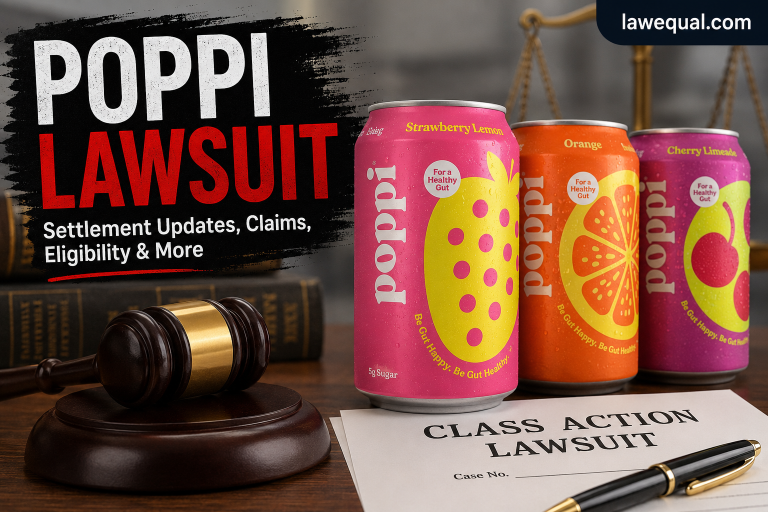
The Poppi Soda Lawsuit became a major consumer case after buyers challenged the popular prebiotic soda brand’s marketing and gut health claims.
The lawsuit alleged that Poppi promoted its drinks as beneficial for gut health even though each can contained only a relatively small amount of prebiotic fiber.
What started as a dispute over product labeling eventually developed into an $8.9 million class action settlement affecting eligible Poppi buyers across the United States.
The case attracted attention because Poppi had built much of its identity around being a modern alternative to traditional soda. Its colorful cans, prebiotic ingredients, lower sugar content compared with many regular sodas, and gut-focused marketing helped the brand become widely recognized.
However, the plaintiffs argued that consumers could reasonably expect meaningful digestive benefits from the way Poppi promoted its products. Poppi disputed the allegations and did not admit wrongdoing by agreeing to settle.
The case has now moved well beyond the original allegations. In April 2026, a federal judge granted final approval to the class action settlement.
A stipulated judgment followed in June 2026, making the latest court developments important for anyone searching for the current status of the case.
What Is the Poppi Soda Lawsuit?
The Poppi Soda Lawsuit is a consumer class action involving Poppi prebiotic beverages and their marketing. Plaintiffs accused VNGR Beverage LLC, the company associated with Poppi, of making misleading representations about the drinks and gut health.
The central dispute did not simply concern whether Poppi contained prebiotic fiber. Instead, plaintiffs questioned whether the amount and type of fiber in each drink justified the health-focused messages used to sell the product.
Consumers may pay more for a food or beverage when they believe it provides added health benefits. The plaintiffs argued that Poppi’s marketing influenced purchasing decisions and allowed the products to command a premium.
Poppi rejected the accusations. The company defended its products and maintained that the lawsuit’s allegations lacked merit.
Rather than continue lengthy litigation, the parties eventually negotiated a class action settlement. The settlement created an $8.9 million fund and included other terms affecting Poppi’s marketing.
Why Was Poppi Soda Sued?
Poppi was sued primarily because plaintiffs believed its advertising created an inaccurate impression about the digestive benefits consumers could receive from drinking the soda.
Poppi marketed itself differently from a standard soft drink. Words connected with prebiotics and gut health appeared prominently in its branding and advertising.
The plaintiffs argued that these representations mattered because consumers increasingly look for functional drinks that offer something beyond flavor and refreshment.
The Gut Health Advertising Claims
One of the best-known parts of the dispute involved statements such as “gut healthy” and the slogan “Be Gut Happy. Be Gut Healthy.”
According to the allegations, those statements could lead an ordinary buyer to believe that drinking Poppi would provide meaningful support for digestive or gut health.
The plaintiffs argued that the actual amount of prebiotic fiber in a single can was too low to provide the level of benefit consumers could reasonably expect from the advertising.
Poppi disagreed with this interpretation and defended its marketing.
Prebiotic Fiber Claims in Poppi Soda
Prebiotics are substances that can serve as food for beneficial microorganisms in the digestive system. They are different from probiotics, which contain live microorganisms.
Poppi used agave inulin as a source of prebiotic fiber. A can was alleged in the litigation to contain about two grams of prebiotic fiber.
The plaintiffs did not argue that Poppi contained no prebiotic ingredient at all. Their argument focused on whether approximately two grams per can could deliver meaningful benefits consistent with the product’s marketing.
This difference is important when understanding the case. The dispute centered largely on the strength and meaning of the advertising rather than the simple presence or absence of fiber.
Allegations of False and Misleading Advertising
Plaintiffs claimed consumers bought Poppi products they might not otherwise have purchased or paid more because of the gut health representations.
In consumer advertising cases, this issue can matter because a health-related message may influence how buyers value a product.
The lawsuit therefore alleged false or misleading advertising and related consumer protection violations.
These remained allegations rather than findings that Poppi intentionally deceived consumers. The settlement resolved the dispute without requiring Poppi to admit wrongdoing.
Who Filed the Poppi Soda Lawsuit?
Kristin Cobbs was one of the central plaintiffs associated with the litigation. The original complaint gained widespread media coverage after it was filed in federal court in California in 2024.
The litigation later included additional claims and plaintiffs before the matters were consolidated.
Also Read: Lululemon Costco Lawsuit
Kristin Cobbs and the Original Class Action
Cobbs alleged that she purchased Poppi products after seeing representations about their prebiotic qualities and gut health benefits.
According to the complaint, she believed Poppi would support digestive health. She later questioned whether the amount of prebiotic fiber in the beverage could actually provide the advertised benefits.
The complaint sought relief not only for Cobbs but also for other consumers who purchased the products under similar circumstances.
That class action structure eventually became important when the parties negotiated a nationwide settlement.
VNGR Beverage LLC’s Role in the Case
VNGR Beverage LLC was named as the defendant in the litigation involving Poppi.
The consolidated federal matter became known as In re VNGR Beverage, LLC Litigation and proceeded in the U.S. District Court for the Northern District of California.
Poppi denied the plaintiffs’ allegations and maintained that its products and marketing were legitimate.
Eventually, both sides agreed to settle the dispute instead of continuing through additional litigation and a possible trial.
What Does the Poppi Soda Lawsuit Claim?
At the heart of the case was a straightforward question: Did Poppi’s marketing make consumers expect greater gut health benefits than the drinks could reasonably provide?
Plaintiffs said yes. Poppi disagreed.
Several specific issues supported the plaintiffs’ argument.
“Gut Healthy” and “Be Gut Happy” Marketing
Poppi’s branding helped separate it from traditional sodas. Instead of focusing only on taste, the company highlighted prebiotics and digestive wellness.
Plaintiffs argued that phrases such as “gut healthy” communicated a health benefit that played an important role in consumers’ purchasing decisions.
According to the lawsuit, consumers could see Poppi as a functional beverage rather than simply another flavored carbonated drink.
That distinction could also influence how much consumers were willing to pay.
How Much Prebiotic Fiber Does Poppi Contain?
The lawsuit focused heavily on the approximately two grams of prebiotic fiber associated with a can of Poppi.
Plaintiffs cited scientific research while arguing that this quantity was too small to provide meaningful prebiotic benefits when consumers drank only one can.
The complaint further alleged that a person might need to consume several cans to reach fiber amounts closer to levels examined in certain research.
That argument created another issue involving sugar consumption.
Were Poppi’s Health Benefits Misleading?
The plaintiffs argued that drinking several cans to obtain additional prebiotic fiber would also increase a person’s sugar intake.
According to their theory, this could undermine the health benefits consumers believed they were receiving.
The lawsuit also raised concerns about agave inulin and potential digestive effects at higher intake levels.
These claims should not be interpreted as a court finding that Poppi is inherently unhealthy or dangerous. They formed part of the plaintiffs’ legal allegations.
Poppi disputed the allegations throughout the case.
Poppi Soda Lawsuit and the $8.9 Million Settlement
The litigation eventually resulted in an agreement establishing an $8.9 million settlement fund.
This settlement became one of the most important developments in the case because eligible consumers received an opportunity to submit claims for cash payments.
The settlement also addressed aspects of Poppi’s future marketing.
Why Did Poppi Agree to Settle?
Settling a lawsuit does not automatically mean a defendant accepts the allegations.
Class action cases can take years to resolve. Both parties may face substantial legal fees, uncertainty, expert costs, discovery expenses, and the possibility of appeals.
A settlement allows the parties to resolve those risks under negotiated terms.
Poppi continued to deny wrongdoing while agreeing to resolve the litigation.
Did Poppi Admit Any Wrongdoing?
No. The settlement was not an admission that Poppi violated the law or intentionally misled customers.
This distinction matters when discussing class action settlements.
Plaintiffs maintained that their claims had merit, while Poppi denied liability. The agreement allowed both sides to end the dispute without a trial determining who would ultimately prevail.
What Does the Settlement Cover?
The settlement covers eligible purchases of Poppi beverages in the United States during the defined class period.
It established an $8.9 million fund from which approved consumer claims, settlement administration expenses, attorneys’ fees and other court-approved costs or awards may be paid according to the agreement.
The settlement also addressed changes involving certain product claims and marketing practices.
Who Was Eligible for the Poppi Soda Lawsuit Settlement?
Eligibility depended primarily on what a consumer purchased, where the purchase occurred, why it was purchased, and when it happened.
The settlement class generally included people in the United States who purchased qualifying Poppi products for household use.
Eligible Poppi Products
The settlement covered Poppi beverages across flavors and package sizes.
That broad definition meant eligibility was not limited to one specific flavor or type of Poppi soda.
Consumers still needed to satisfy the other settlement requirements.
Qualifying Purchase Dates
The settlement class covered qualifying purchases made from January 23, 2020 through July 18, 2025.
The purchase needed to occur in the United States.
Products purchased for household use could qualify, while purchases for resale or distribution did not fall within the ordinary class definition.
Do You Need Proof of Purchase?
The settlement allowed certain claims without receipts or other proof of purchase.
However, documentation affected the amount a claimant could seek.
Consumers with qualifying proof could claim based on documented purchases under the settlement’s payment formula.
Those without proof were subject to a household cap.
How Much Could Consumers Get From the Poppi Settlement?
Settlement compensation depended on the type and quantity of Poppi products purchased.
The listed base amounts included:
Single can: $0.75 per unit
4-pack: $3.00 per unit
8-pack: $6.00 per unit
12-pack: $9.00 per unit
15-pack: $9.00 per unit
These amounts represented the settlement’s claim calculation before any adjustments required under its terms.
Payment for Individual Poppi Cans
An eligible single can could produce a base claim of $0.75.
Consumers with records supporting larger numbers of purchases could potentially claim more than people who lacked documentation.
However, the actual payment could depend on the total number and value of approved claims.
Payment for 4-Pack, 8-Pack, 12-Pack, and 15-Pack Purchases
The settlement used different values for different package sizes.
An eligible 4-pack carried a $3 claim value, while an 8-pack carried a $6 value.
Qualifying 12-packs and 15-packs each carried a $9 base claim value.
These amounts made purchase records especially useful for consumers who bought Poppi regularly during the class period.
Maximum Payment Without Proof of Purchase
Consumers who did not have proof of purchase could still submit eligible claims, but the settlement limited these claims to $16 per household.
This made the settlement accessible to buyers who no longer had receipts from purchases made years earlier.
It also reduced the risk of unlimited unsupported claims.
Minimum Settlement Payment Per Household
The settlement documents provided rules for distributing the available net settlement fund among approved claimants.
Actual payments can differ from initial claim calculations because the final distribution depends on factors such as the number of valid claims and available settlement funds.
Consumers should therefore distinguish between a claim’s calculated value and the amount ultimately distributed.
How to File a Poppi Soda Lawsuit Claim
Eligible consumers had to submit a valid claim by the settlement deadline to seek a payment.
The claims process asked consumers to provide identifying information and details about qualifying purchases.
Information Required for a Claim
Claimants generally needed to identify themselves and provide the information requested by the settlement administrator.
They also needed to state information about their Poppi purchases.
Providing accurate information was important because claims could be reviewed for validity.
Proof of Purchase Requirements
Receipts, purchase records, or similar documentation could support claims involving documented purchases.
Consumers without receipts were still able to participate under the settlement’s no-proof rules.
However, the $16 household cap applied to claims without proof.
Poppi Settlement Claim Deadline
The deadline to submit a claim was September 26, 2025.
This deadline is important for anyone finding older articles that still instruct readers to file a claim.
As of 2026, the claims period has already closed.
Is the Poppi Soda Settlement Claim Deadline Over?
Yes. The claim submission deadline was September 26, 2025.
Consumers generally cannot submit a new timely claim after that deadline simply because they recently learned about the settlement.
The same settlement process also included deadlines for other actions, such as exclusion or objections.
People searching for the Poppi settlement in 2026 should therefore pay close attention to publication dates. Articles published before September 2025 may still display instructions that are no longer current.
Poppi Soda Lawsuit Payout Date
The payout date has generated significant interest among people who submitted claims.
The settlement originally explained that approved payments would be distributed after final approval and after the settlement was no longer subject to appeal or review.
The timing therefore depended on more than the date of the final fairness hearing.
When Will Settlement Payments Be Sent?
The settlement notice stated that approved claims would generally be distributed within 90 days after the settlement was no longer subject to appeal or review, unless the court ordered otherwise.
The court granted final settlement approval on April 14, 2026.
A stipulated judgment was later signed on June 15, 2026, and the civil case was terminated.
However, claimants should avoid treating an estimated payment window as a guaranteed date. Claim processing, appeal periods, administrative work, court orders, and other factors can affect distribution timing.
What Could Delay Poppi Settlement Payments?
Large settlements require administrators to review claims before sending money.
The administrator may need to identify duplicate claims, confirm documentation, calculate final payment amounts, address disputed claims, and determine how the net settlement fund should be distributed.
Court proceedings can also affect timing.
For this reason, a settlement approval date and a payout date are not necessarily the same thing.
Poppi Soda Lawsuit 2026 Latest Update
The most important Poppi Soda Lawsuit development in 2026 is that the federal court granted final approval to the settlement.
Judge Haywood S. Gilliam Jr. granted the motion for final approval on April 14, 2026.
The court later addressed attorneys’ fees, expenses, and incentive awards in June.
A stipulated judgment signed June 15, 2026 stated that the civil case was terminated.
Current Settlement Status
The settlement has received final court approval.
This represents a major change from information published during 2025, when the settlement still awaited final approval.
Consumers researching the case should therefore be cautious about older reports that describe the agreement only as “proposed.”
The litigation has advanced beyond that stage.
What Happens After Settlement Approval?
After approval, the settlement administration process moves toward completing claim review and distributing payments to approved claimants according to the settlement terms.
Administrative tasks may continue even after the court resolves the major legal questions.
Claimants should keep any confirmation emails or claim numbers they received when filing.
Can Consumers Still Submit a Claim?
The regular claims deadline has passed.
The deadline was September 26, 2025, so consumers discovering the case in 2026 generally cannot file a new timely claim through the original claims process.
This is one reason why current information matters when researching class action settlements.
What Changes Did Poppi Agree to Make?
The settlement involved more than money.
It also addressed the way Poppi could use certain gut health representations in marketing and labeling.
Such non-monetary terms can be important in consumer class actions because they may influence how products are presented in the future.
Changes to Product Packaging
The settlement addressed labeling and marketing practices associated with the disputed representations.
Consumers may therefore notice differences between older Poppi packaging and newer branding.
Packaging changes can also happen for reasons unrelated to litigation, so not every design update should automatically be attributed to the lawsuit.
Changes to Gut Health Marketing Claims
The dispute centered heavily on representations that suggested gut health benefits.
As part of resolving the litigation, Poppi agreed to terms governing certain future representations.
These provisions seek to address the same marketing issues that led consumers to bring the case.
Poppi’s Response to the Lawsuit
Poppi strongly disputed the original allegations.
When the lawsuit first attracted national attention, the company described it as baseless and said it stood behind its products.
The company maintained that its mission involved creating a better-for-you soda option and defended the quality of its products.
Its decision to settle should not be interpreted as an admission that the plaintiffs proved their allegations.
Settlements often reflect practical business and legal considerations rather than a concession that one side’s version of events is correct.
Is Poppi Soda Actually Good for Gut Health?
The lawsuit naturally raised a larger question about Poppi’s health value.
There is no simple answer because a person’s overall diet, fiber intake, health needs, serving size, and other factors matter more than one beverage.
Prebiotic fiber can form part of a balanced diet. However, consumers should not assume that any food or drink containing a prebiotic automatically produces major digestive benefits.
What Is Agave Inulin?
Inulin is a type of dietary fiber found naturally in various plants.
It can function as a prebiotic because certain gut microorganisms can use it.
Poppi has used agave inulin as part of its formulation.
The legal dispute did not simply claim that inulin has no function. Instead, it questioned whether the quantity in Poppi supported the strength of the brand’s gut-focused advertising.
How Much Fiber Is in a Can of Poppi?
The litigation repeatedly referenced about two grams of prebiotic fiber per can.
That figure became central to the plaintiffs’ theory.
They argued that consumers would need considerably more to obtain the type of meaningful prebiotic benefit they believed Poppi’s marketing suggested.
Poppi disputed the plaintiffs’ interpretation and defended its products.
What Health Experts Say About Prebiotic Soda
Nutrition experts generally view fiber as an important part of a healthy diet.
However, people can obtain prebiotic fibers from many foods, including vegetables, fruits, legumes, whole grains, onions, garlic, and other plant foods.
A prebiotic soda can contribute some fiber, but it should not automatically replace a varied diet rich in naturally fiber-containing foods.
Individual digestive tolerance also differs. Some people may experience bloating, gas, or discomfort when they consume larger amounts of certain fermentable fibers such as inulin.
Poppi Lawsuit Timeline
Understanding the timeline makes the case much easier to follow.
The litigation moved from a widely reported consumer complaint in 2024 to settlement negotiations, a claims process in 2025, and final court approval in 2026.
Lawsuit Filed in 2024
Kristin Cobbs filed her lawsuit in federal court in California in 2024.
The complaint quickly attracted attention because Poppi had become a recognizable name in the fast-growing prebiotic soda market.
The allegations focused on whether the company’s gut health marketing overstated what consumers could reasonably expect from approximately two grams of prebiotic fiber.
Settlement Negotiations
As the litigation progressed, related claims were consolidated and the parties eventually entered settlement negotiations.
Settling gave both sides an opportunity to avoid the expense and uncertainty associated with further litigation.
The resulting agreement established an $8.9 million settlement fund and provided benefits for eligible class members.
$8.9 Million Settlement Agreement
The settlement covered qualifying purchases made between January 23, 2020 and July 18, 2025.
Consumers could submit claims for purchases of different Poppi package sizes.
People without proof of purchase could seek up to $16 per household, while documented claims could be calculated according to qualifying purchases and the settlement formula.
Claim Deadline and Settlement Process
Consumers had until September 26, 2025 to submit claims.
The final fairness hearing was held on November 20, 2025.
Although the hearing occurred in November, final approval did not arrive until April 2026.
That gap is important because a fairness hearing does not always mean payments will immediately follow.
2026 Settlement Status
On April 14, 2026, the federal court granted final approval.
The court addressed the remaining attorneys’ fees and incentive award issues in June 2026.
On June 15, 2026, the court entered a stipulated judgment and terminated the civil case.
These developments make 2026 a key year in the Poppi settlement timeline.
What the Poppi Soda Lawsuit Means for Consumers
The Poppi case illustrates how closely companies must consider the wording they use when marketing foods and beverages as providing health benefits.
Modern consumers often look beyond calories and taste.
Terms such as “prebiotic,” “probiotic,” “gut healthy,” “immune support,” and similar phrases can influence purchasing decisions.
When a company connects a product to health benefits, consumers may reasonably want to know how much of the active ingredient is present and what evidence supports the representation.
The lawsuit also shows why consumers should read nutrition labels rather than relying only on front-of-package marketing.
A product can contain a beneficial ingredient without necessarily providing a large amount of it.
At the same time, the allegations in a lawsuit should not automatically be treated as proven scientific facts.
Courts, settlements, companies, plaintiffs, and researchers may address different questions.
Could the Poppi Lawsuit Affect Other Prebiotic Soda Brands?
Poppi is part of a much larger functional beverage market.
Prebiotic and probiotic sodas have gained popularity as consumers search for alternatives to traditional soft drinks.
The Poppi litigation could encourage other beverage companies to examine how they describe digestive benefits.
Brands may choose more precise language, provide clearer nutritional information, or avoid making claims that could create expectations beyond what scientific evidence supports.
The case may also make consumers more careful when evaluating functional beverages.
People increasingly want to know not only whether a product contains a trendy ingredient, but how much it contains and whether that amount matters.
However, the settlement itself applies to the Poppi litigation. It does not establish that other prebiotic soda brands have violated consumer protection laws.
Each product and advertising claim would need to be evaluated separately.
Frequently Asked Questions About the Poppi Soda Lawsuit
Is the Poppi Soda Lawsuit Real?
Yes. The case was filed in federal court and developed into consolidated litigation involving Poppi’s gut health marketing.
The litigation ultimately produced an $8.9 million class action settlement that received final court approval in April 2026.
How Much Is the Poppi Lawsuit Settlement?
The settlement fund totals $8.9 million.
That amount does not mean every claimant receives an equal share. Payments depend on approved claims and the distribution rules established by the settlement.
Who Qualifies for the Poppi Settlement?
The settlement class generally covers people in the United States who bought Poppi beverages for household use, rather than resale or distribution, between January 23, 2020 and July 18, 2025.
Additional exclusions and settlement requirements apply.
Can I Still File a Poppi Settlement Claim?
The regular claim deadline has passed.
Eligible consumers were required to submit their claims by September 26, 2025. Therefore, someone first learning about the settlement in 2026 generally cannot submit a new timely claim through the original process.
Do I Need a Receipt to Get a Poppi Settlement Payment?
A receipt was not required for every claim.
The settlement allowed eligible consumers without proof of purchase to submit claims, but those claims were limited to a maximum of $16 per household.
Proof of purchase allowed qualifying consumers to support claims based on documented purchases.
How Much Money Can I Get From the Poppi Lawsuit?
The base claim values included $0.75 for an individual can, $3 for a 4-pack, $6 for an 8-pack, and $9 for a 12-pack or 15-pack.
Consumers without proof of purchase faced a $16 household limit.
The final amount paid can differ from the calculated claim amount depending on the settlement’s distribution rules and the total approved claims.
When Is the Poppi Lawsuit Payout Date?
The settlement documents did not promise every claimant a specific calendar payment date.
They provided for distribution of approved claims after the settlement became final and was no longer subject to appeal or review, subject to the settlement terms and any court orders.
Final approval occurred on April 14, 2026, while a stipulated judgment terminating the civil case was entered on June 15, 2026.
Why Was Poppi Accused of False Advertising?
Plaintiffs argued that Poppi emphasized gut health even though each can contained only about two grams of prebiotic fiber.
They claimed that this amount did not support the level of digestive benefit consumers could reasonably take from the marketing.
Poppi disputed those allegations.
Did Poppi Admit to Misleading Customers?
No.
Poppi denied wrongdoing, and the settlement did not require the company to admit that the plaintiffs’ allegations were true.
The agreement resolved the legal dispute without a trial deciding liability.
Is Poppi Soda Still Safe to Drink?
The lawsuit was mainly a dispute about marketing and claimed gut health benefits, not a finding that Poppi soda is unsafe for the general public.
People should therefore avoid interpreting the settlement as a product safety ruling.
Consumers with specific dietary concerns, digestive problems, allergies, or medical conditions should consider the ingredient and nutrition information and seek professional medical advice when appropriate.
Final Thoughts on the Poppi Soda Lawsuit
The Poppi Soda Lawsuit shows how health-focused marketing can become a major legal issue when consumers question whether a product delivers the benefits they believe its advertising promises. Plaintiffs challenged Poppi’s gut health representations and the amount of prebiotic fiber in its beverages, while Poppi denied wrongdoing and defended its products.
The dispute eventually resulted in an $8.9 million class action settlement covering qualifying U.S. purchases from January 23, 2020 through July 18, 2025. The claim deadline passed on September 26, 2025, and the federal court granted final settlement approval on April 14, 2026. A stipulated judgment followed in June 2026, bringing the civil litigation to an end while the settlement administration process remained important for approved claimants.
For consumers, the case offers a useful lesson about functional food and beverage marketing. Words such as prebiotic and gut healthy can sound powerful, but buyers should still look at serving sizes, ingredient quantities, nutrition facts, and the evidence behind specific health claims. The Poppi Soda Lawsuit ultimately became about more than one trendy soda brand. It highlighted the growing importance of clear advertising as health-focused drinks become a bigger part of the beverage market.