Isotonix Lawsuit: FDA Warning, Market America Case, and Current Status
The term Isotonix Lawsuit generally refers to legal and regulatory issues connected to Isotonix dietary supplements and their manufacturer, Market America.
Unlike many major pharmaceutical lawsuits, the Isotonix legal discussion is not centred on one nationwide class action involving every product. Instead, most concerns relate to government regulatory actions, marketing claims, and lawsuits involving Market America’s business practices.
Many consumers search for an Isotonix lawsuit because they have seen discussions about:
- FDA warning letters
- Product advertising claims
- Health benefit claims
- Supplement safety
- Market America lawsuits
- Possible consumer settlements
These topics have caused many buyers to question whether the supplements were marketed appropriately and whether the company complied with federal regulations.
Is There an Active Isotonix Class Action Lawsuit?
One of the most common questions people ask is whether there is an active nationwide Isotonix class action lawsuit.
Based on publicly available court records available at the time of writing, there is no widely recognised nationwide class action settlement specifically against all Isotonix products.
However, that does not mean Isotonix has never faced legal attention.
Instead, legal concerns have included:
- FDA regulatory enforcement
- Marketing claim investigations
- Consumer complaints
- Litigation involving Market America
- Allegations related to the company’s multi-level marketing (MLM) business model
Because these issues often involve the same company, many online articles refer to them collectively as the Isotonix Lawsuit.
Consumers should also understand that lawsuits may be filed, dismissed, settled, or changed over time. Court filings and regulatory actions can also involve specific products instead of an entire product line.
Why Is Isotonix Facing Legal Attention?
Several different issues have brought Isotonix and Market America into public discussion over the years.
These concerns do not all involve the same legal case. Instead, they include regulatory findings, advertising questions, and litigation involving the parent company.
FDA Warning Letter to Market America
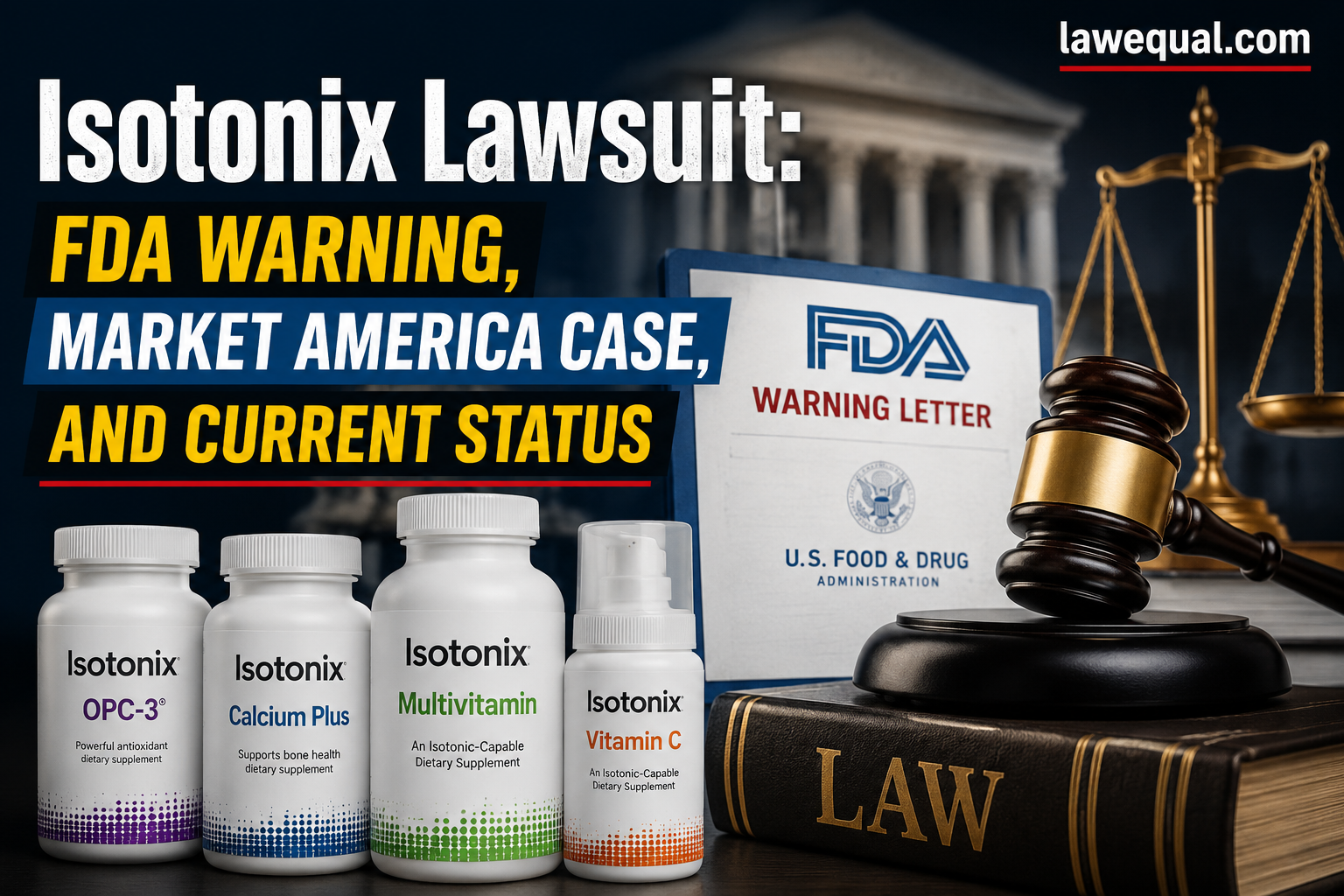
One of the biggest reasons people search for the Isotonix Lawsuit is the FDA warning letter issued to Market America.
The U.S. Food and Drug Administration reviewed promotional materials for certain Isotonix products and found concerns about disease-related claims.
According to the FDA, some marketing statements suggested that supplements could diagnose, treat, cure, or prevent diseases.
Under U.S. law, dietary supplements cannot generally make drug-like claims unless approved through the appropriate regulatory process.
When supplements are promoted with claims that resemble prescription drug advertising, regulators may consider them unapproved drugs.
This FDA action became one of the most discussed events connected with Isotonix.
Marketing and Advertising Allegations
Marketing claims have also received significant attention.
Isotonix products are promoted as nutritional supplements using an isotonic delivery system that claims to improve nutrient absorption.
Some promotional materials have highlighted benefits involving:
- Heart health
- Immune support
- Brain function
- Joint health
- Energy
- Healthy ageing
Regulators have examined whether some advertising language crossed the line into medical claims rather than nutritional support claims.
This distinction is important because dietary supplements and prescription medicines are regulated differently.
Product Safety and Consumer Complaints
Like many supplement brands, Isotonix has received consumer feedback over the years.
Some users report positive experiences, while others have shared concerns involving:
- Digestive discomfort
- Allergic reactions
- Product effectiveness
- High product prices
- Customer service
- Refund issues
Individual complaints do not automatically prove that a product is unsafe.
However, when enough complaints appear, they often increase public interest and encourage closer regulatory review.
Consumers should always discuss dietary supplements with a healthcare professional, especially if they have medical conditions or take prescription medications.
Also Read: Hexclad Lawsuit
Who Owns Isotonix?
Understanding the company behind the products helps explain why many legal discussions focus on Market America rather than Isotonix alone.
Isotonix is one of several supplement brands owned by Market America.
The company sells nutritional supplements, health products, beauty items, and wellness products through independent distributors.
What Is Market America?
Market America is a North Carolina-based company founded in 1992.
The business operates using a direct selling model, where independent distributors purchase products and earn commissions through product sales and recruitment.
The company markets numerous brands covering:
- Vitamins
- Minerals
- Nutritional supplements
- Weight management
- Beauty products
- Skincare
- Personal care
Isotonix remains one of its best-known supplement brands.
How the MLM Business Model Works
Market America uses a multi-level marketing (MLM) structure.
Under this system, distributors can earn income through:
- Personal product sales
- Team sales
- Recruiting new distributors
- Performance bonuses
Supporters say MLM businesses provide entrepreneurial opportunities.
Critics argue that some MLM companies encourage recruitment more than retail sales.
Because of this debate, Market America’s business practices have occasionally become part of broader legal disputes unrelated to specific Isotonix supplements.
Isotonix Lawsuit Timeline
Understanding the timeline helps separate facts from internet rumours.
Different legal and regulatory events have occurred over several years, and many online articles combine them under one headline.
Below is a simplified overview.
Key Events
1992
Market America is founded in the United States.
Late 1990s
The company expands its nutritional supplement business and launches additional wellness products, including the Isotonix line.
2000s
The brand grows internationally through independent distributors.
Following Years
Consumer discussions increase regarding supplement claims, pricing, and the MLM business model.
FDA Regulatory Action
The FDA issues a warning letter concerning promotional claims for certain products marketed by Market America.
Recent Years
Consumers continue searching online for updates regarding lawsuits, settlements, and regulatory developments involving Isotonix and Market America.
Regulatory Actions
Government agencies monitor dietary supplement companies to ensure compliance with federal laws.
When regulators identify possible issues, they may issue:
- Warning letters
- Inspection reports
- Compliance requests
- Marketing reviews
- Product claim investigations
These actions do not always mean a company has been found legally liable in court.
Instead, they often require businesses to correct marketing materials or improve compliance with regulations.
Court Developments
Public interest in the Isotonix Lawsuit continues because consumers often search for new court filings and settlement announcements.
While Market America has been involved in various legal matters over the years, readers should distinguish between:
- FDA regulatory actions
- Civil lawsuits
- Consumer complaints
- Class action litigation
- MLM-related legal disputes
Each involves different legal standards and different outcomes.
Understanding these differences helps consumers evaluate information more accurately instead of relying on misleading social media posts or rumours.
Main Allegations in the Isotonix Lawsuit
Many online discussions about the Isotonix Lawsuit combine different legal and regulatory issues into one topic. In reality, the concerns involve several separate matters, including product advertising, FDA compliance, consumer protection, and lawsuits involving Market America. Understanding these allegations helps consumers separate verified facts from online rumours.
Misleading Health Claims
One of the most discussed issues connected with the Isotonix Lawsuit involves marketing claims made about certain dietary supplements.
Dietary supplements may describe how nutrients support normal body functions. However, they generally cannot claim to diagnose, treat, cure, or prevent diseases unless approved as medicines.
Regulators have questioned whether some promotional materials for Isotonix products crossed that legal line.
Examples of health topics mentioned in promotional materials have included:
- Heart health
- Immune system support
- Joint health
- Brain function
- Blood circulation
- Healthy ageing
The concern was not simply that these benefits were mentioned. Instead, regulators focused on whether the wording suggested that the products could treat or prevent diseases.
When supplements appear to make drug-like claims, they may fall under stricter federal regulations.
Absorption Rate Claims
Isotonix products are marketed using an “isotonic” delivery system.
The company states that this formula is designed to help nutrients reach the digestive system in a form that supports absorption.
Many consumers purchase Isotonix supplements because of these claims.
However, some critics have questioned whether the advertised absorption benefits are supported by enough high-quality scientific evidence across all products.
This has led to public debate about:
- Bioavailability
- Nutrient absorption
- Scientific research
- Marketing language
- Clinical evidence
It is important to understand that discussions about scientific evidence are different from proving legal wrongdoing.
Companies often disagree with critics about how research should be interpreted.
Failure to Report Serious Adverse Events
Another issue discussed in relation to dietary supplement regulations involves adverse event reporting.
Federal law requires supplement companies to maintain records of serious adverse events reported by consumers.
Examples include:
- Hospitalisation
- Serious allergic reactions
- Life-threatening events
- Permanent disability
- Death
There is no public evidence showing that every Isotonix product failed to meet these requirements.
However, regulators expect supplement manufacturers to maintain complete records and follow all reporting obligations.
Consumers who experience unexpected side effects should report them to both their healthcare provider and the appropriate regulatory agency.
Pyramid Scheme Allegations Against Market America
Many searches for the Isotonix Lawsuit actually relate to lawsuits involving Market America’s business model rather than the supplements themselves.
Market America operates as a multi-level marketing (MLM) company.
Distributors can earn money by:
- Selling products
- Recruiting new distributors
- Building sales organisations
- Receiving commissions and bonuses
Critics have argued that some MLM companies place too much emphasis on recruitment.
Supporters respond that distributors can earn income through legitimate product sales.
Because of this long-running debate, Market America has faced legal challenges over aspects of its business practices.
These claims should not automatically be interpreted as proof that every Isotonix supplement is unsafe or defective.
FDA Warning Letter Explained
The FDA warning letter remains one of the most important reasons people search for the Isotonix Lawsuit.
Many consumers first learned about Isotonix after reading news articles discussing federal regulators and supplement advertising.
Understanding what the FDA actually said provides valuable context.
What the FDA Found
The U.S. Food and Drug Administration reviewed promotional materials used to market certain products sold by Market America.
According to the agency, some advertising statements suggested that certain supplements could be used to diagnose, cure, mitigate, treat, or prevent diseases.
Examples of disease-related topics referenced in promotional content included conditions affecting:
- The heart
- Blood vessels
- Diabetes
- Arthritis
- Cancer
- Other medical diseases
The FDA stated that products making these types of claims may legally be considered drugs rather than dietary supplements if they lack the required approvals.
This issue focused primarily on marketing language rather than contamination or manufacturing defects.
How the Company Responded
Following the FDA warning letter, Market America indicated that it would review the agency’s concerns and take appropriate action.
Companies receiving FDA warning letters commonly respond by:
- Reviewing advertising materials
- Updating websites
- Revising product descriptions
- Training distributors
- Improving compliance procedures
Receiving a warning letter does not automatically mean a company admits wrongdoing.
Instead, it begins a regulatory process intended to correct potential compliance issues.
Why the Warning Matters
The FDA warning letter remains important because it reminds both companies and consumers that dietary supplement advertising has legal limits.
For consumers, it highlights the need to:
- Read product labels carefully.
- Avoid relying only on marketing claims.
- Consult healthcare professionals before starting supplements.
- Understand that supplements are not approved medicines.
The warning also increased public interest in whether additional lawsuits or regulatory actions might follow.
Isotonix Products Involved in the Legal Controversy
When people search for the Isotonix Lawsuit, they often want to know which supplements have been discussed most often.
Although the Isotonix product line includes many vitamins and nutritional supplements, several products appear more frequently in public discussions because of their popularity and marketing claims.
Isotonix OPC-3
Isotonix OPC-3 is one of the company’s flagship antioxidant supplements.
It contains ingredients such as:
- Grape seed extract
- Pine bark extract
- Bilberry extract
- Citrus bioflavonoids
The supplement is promoted as supporting healthy circulation and antioxidant protection.
Because it is one of the brand’s best-selling products, it has frequently been mentioned in discussions about Isotonix marketing practices.
Isotonix Multivitamin
The Isotonix Multivitamin provides a combination of essential vitamins and minerals.
Consumers often purchase it for daily nutritional support.
Marketing materials have highlighted benefits including:
- Energy production
- Immune support
- General wellness
- Healthy metabolism
Like other supplements, these products must be marketed within FDA rules governing dietary supplements.
Isotonix Vitamin C and Other Supplements
The Isotonix product range also includes:
- Vitamin C
- Calcium Plus
- Magnesium
- B-Complex
- Digestive enzymes
- Probiotics
- Fish oil
- Joint support formulas
Many of these supplements have been promoted as supporting overall health rather than treating specific diseases.
Consumers should always follow the recommended dosage and discuss supplement use with a qualified healthcare provider, particularly if they have existing medical conditions or take prescription medicines.
Is There an Isotonix Lawsuit Settlement?
One of the biggest reasons people search for the Isotonix Lawsuit is to find out whether a settlement has been reached. Many websites mention lawsuits, FDA actions, and Market America, which can make it difficult to understand the current legal status.
At the time of writing, there is no publicly confirmed nationwide settlement that applies to all Isotonix consumers or all Isotonix products. Consumers should be cautious of websites claiming that everyone qualifies for compensation without official court documentation.
Has Any Settlement Been Reached?
Currently, there is no verified nationwide Isotonix lawsuit settlement covering every purchaser of Isotonix supplements.
This is important because many internet searches combine different legal matters into one topic.
Consumers often confuse:
- FDA warning letters
- Consumer complaints
- Market America lawsuits
- Class action lawsuits
- Product liability claims
Each of these is a separate legal issue.
If a future settlement is approved by a court, official notices are normally sent to eligible consumers or published through recognised legal channels.
Until then, buyers should rely on verified court information rather than social media rumours.
Who Could Qualify If a Future Settlement Is Announced?
Although there is currently no nationwide settlement, some consumers wonder who could qualify if one is approved in the future.
Eligibility would depend on the court’s decision and the specific allegations involved.
Possible factors could include:
- Purchasing eligible Isotonix products
- Buying products during a specified time period
- Meeting legal requirements established by the court
- Providing proof of purchase if required
Every settlement is different.
No one should assume they automatically qualify unless official settlement documents clearly state the eligibility rules.
Can Consumers File an Isotonix Lawsuit?
Some consumers may believe they have suffered financial loss or health-related problems after using a dietary supplement.
Whether someone can file an Isotonix Lawsuit depends on the facts of their individual situation.
Only a qualified attorney can evaluate whether a person may have a valid legal claim.
Who May Have a Legal Claim?
Every case is different.
A person may decide to speak with a lawyer if they believe they experienced:
- Serious physical injuries
- Significant financial losses
- Misleading product advertising
- Unexpected side effects
- Other legally recognised damages
Speaking with a lawyer does not guarantee that a lawsuit will be filed or that compensation will be awarded.
Legal professionals review medical records, purchase history, and other evidence before determining whether a claim may exist.
What Evidence Should Consumers Keep?
If someone believes they may have a legal claim, keeping accurate records can be helpful.
Useful documents may include:
- Product packaging
- Purchase receipts
- Order confirmations
- Medical records
- Doctor’s recommendations
- Pharmacy records
- Photographs of the product
- Emails with the company
Maintaining organised records can make it easier to answer questions if legal advice is sought later.
Consumers should never alter or destroy evidence related to a potential claim.
Impact of the Isotonix Lawsuit on Consumers
Whether or not a nationwide class action exists, public discussion about the Isotonix Lawsuit has influenced how many people view dietary supplements.
Consumers today are more likely to research products before making a purchase.
They also pay closer attention to product labels, scientific studies, and regulatory actions.
Consumer Trust
Trust is one of the most valuable assets for any health and wellness company.
When legal disputes or regulatory actions become public, some consumers become more cautious.
Many buyers now compare:
- Ingredient lists
- Scientific research
- Third-party testing
- Customer reviews
- Company reputation
- Regulatory history
This increased research helps consumers make more informed purchasing decisions.
Product Sales and Brand Reputation
Public legal discussions can affect a company’s reputation even when no nationwide settlement exists.
Online articles, news reports, and social media discussions often influence consumer behaviour.
Some customers continue purchasing Isotonix products because they are satisfied with their experience.
Others choose alternative supplements after reading about regulatory concerns or legal disputes involving Market America.
Brand reputation often depends on:
- Product quality
- Customer service
- Regulatory compliance
- Transparency
- Scientific support
- Consumer confidence
Companies that respond openly to concerns often have a better chance of maintaining customer trust.
Isotonix Company Response
Market America has continued to market Isotonix supplements while addressing regulatory issues raised over the years.
Following FDA concerns, the company indicated that it would review promotional materials and make changes where appropriate to comply with federal requirements.
Like many supplement manufacturers, the company has stated that its products are intended to support general health and wellness rather than replace medical treatment.
The company has also continued to promote its Isotonix line through its independent distributor network.
Consumers should remember that a company’s public response does not determine legal liability.
Instead, courts and regulatory agencies evaluate evidence before reaching legal conclusions.
For buyers, the most practical approach is to:
- Read product labels carefully.
- Follow recommended serving instructions.
- Discuss supplements with a healthcare professional.
- Avoid relying solely on advertising claims.
- Stay informed about future regulatory or legal developments.
Being an informed consumer is often the best way to make safe purchasing decisions.
Frequently Asked Questions
Is there really an Isotonix lawsuit?
Yes, the phrase Isotonix Lawsuit is widely searched online. However, it often refers to a mix of regulatory actions, consumer concerns, and legal matters involving Market America rather than one single nationwide lawsuit against every Isotonix product.
Consumers should distinguish between FDA warning letters, civil lawsuits, and class action cases because they are different legal processes.
Is there an Isotonix class action lawsuit?
At the time of writing, there is no publicly confirmed nationwide class action lawsuit settlement covering all Isotonix products.
Legal cases can change over time. New lawsuits may be filed, dismissed, or settled, so consumers should rely on official court information rather than rumours shared on social media.
What is the FDA warning against Market America?
The FDA issued a warning letter after reviewing promotional materials for certain products marketed by Market America.
The agency stated that some advertising appeared to make disease-related claims that are generally not permitted for dietary supplements without the required approvals.
The warning focused on marketing and promotional language rather than stating that every Isotonix product was unsafe.
Is Isotonix safe to use?
Many consumers have used Isotonix supplements for years without reporting serious problems.
However, every person responds differently to dietary supplements.
Factors that may affect safety include:
- Existing medical conditions
- Prescription medications
- Allergies
- Pregnancy or breastfeeding
- Individual health history
Consumers should always read product labels carefully and consult a qualified healthcare professional before starting any new supplement.
Can I join the Isotonix lawsuit?
Whether someone can join a lawsuit depends on the facts of the specific case.
If a future class action lawsuit is certified by a court, eligibility requirements will be explained in official legal notices.
Until then, consumers who believe they have experienced harm should consider seeking independent legal advice to understand their options.
Has there been an Isotonix lawsuit settlement?
There is currently no publicly verified nationwide Isotonix lawsuit settlement covering all consumers.
Because legal matters can change, anyone searching for settlement information should verify that updates come from reliable legal or government sources.
Are Isotonix supplements still available?
Yes. Isotonix supplements continue to be sold through Market America’s independent distributor network in many regions.
Availability may vary depending on the product and country.
Consumers should purchase supplements only from authorised sources to reduce the risk of counterfeit products.
What should consumers do before using dietary supplements?
Before using any dietary supplement, consumers should take a few simple precautions.
These include:
- Reading the ingredient list.
- Following the recommended serving size.
- Checking for possible allergies.
- Talking with a doctor if taking prescription medicines.
- Buying products from trusted sellers.
- Reporting unexpected side effects to a healthcare provider.
Making informed decisions helps reduce unnecessary risks.
Final Thoughts
The Isotonix Lawsuit continues to attract attention because it involves topics that matter to consumers, including product advertising, FDA compliance, supplement safety, and Market America’s business practices. While many online articles discuss legal claims and regulatory actions, it is important to understand that not every concern results in a nationwide class action or settlement.
Consumers should carefully separate verified facts from speculation. The FDA warning letter focused on certain promotional claims, while other legal matters have involved broader issues related to Market America. These are distinct from proving that every Isotonix product is defective or unsafe.
If you currently use Isotonix supplements, staying informed is the best approach. Read product labels, follow the recommended directions, discuss supplements with your healthcare provider when necessary, and keep an eye on future legal or regulatory developments.
As new information becomes available, the Isotonix Lawsuit may continue to evolve. For now, understanding the available facts allows consumers to make informed decisions based on evidence rather than rumours, helping them choose dietary supplements with greater confidence.